
Cannabutter Recipe: The Machine Method
Written by the ÉCRU team · Published August 24, 2026
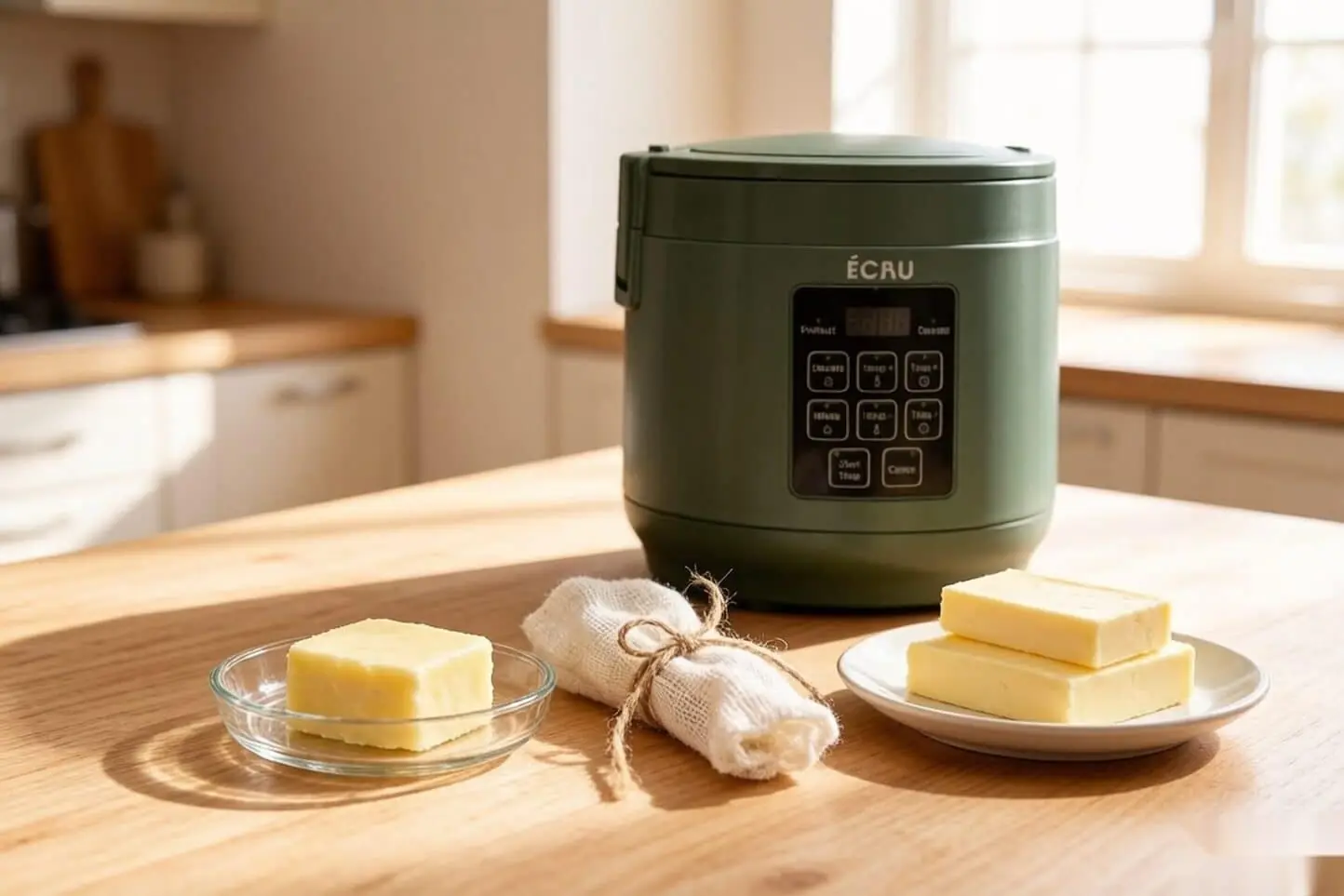
Set cannabutter, cheesecloth, butter, and a decarboxylator ready for a machine recipe (illustration).
Quick answer: cannabutter recipe, machine method
This is the cannabutter recipe for people who do not want to babysit a saucepan: decarb 7 g of coarsely ground flower at 240°F (115°C) for 30-40 minutes, then infuse it in 227 g (2 sticks) of butter with a cup of water held at 160-190°F (70-90°C) for 1-2 hours, strain without squeezing, and let the fat firm up in the cold.
Two stages, not one. A machine that only melts and mixes gives you butter that tastes like cannabis and does very little else; the dry heat stage before the fat is what makes the batch work when you eat it. Every failure mode people post about - weak butter, gritty butter, butter that tastes like lawn clippings - traces back to skipping stage one or rushing stage two.
The recipe below shows how to make cannabutter in a machine - a countertop decarboxylator that can hold two separate temperature bands. The stovetop version is the same method with the same two numbers; only the appliance changes.
What you need
| Item | Amount | Why this and not something else |
|---|---|---|
| Flower, coarsely ground | 7 g (quarter ounce) | Coarse, like coffee grounds. A fine grind turns to dust that passes straight through cheesecloth and leaves the finished butter gritty |
| Unsalted butter | 227 g (1 cup / 2 sticks) | Unsalted keeps the sodium in whatever you cook with it under your control. European-style butter has more fat and less water, so there is less to emulsify and the cold rinse separates more cleanly |
| Water | 240 ml (1 cup) | Keeps the plant material submerged and buffers the pan against scorching. Because fat and water separate as they cool, the same cup of water is what lets you rinse the set butter clean later |
| Cheesecloth or a mesh infusion bag | 1 sheet / 1 bag | A coffee filter works in principle and clogs in practice once butter hits it |
| Heatproof glass jar with a lid | 1 L (quart size) | A wide-mouth quart takes the whole batch with room to stir. Butter distributes unevenly as it sets, so under-size the jar and you cannot mix it back to even |

Butter, water, ground flower, cheesecloth, and a jar - the full ingredient list (illustration).
Grind the flower before you measure the decarb, spread it thin, and start it into the machine while the butter sits in the fridge. The order matters: nothing about stage two can rescue an incomplete stage one.
Why this recipe decarbs before it infuses
Cannabis stores its cannabinoids as acids - THCA rather than THC - and the acid form is not what produces the effect people want from an edible. Heat strips the carboxyl group off the molecule, and that conversion needs temperature held for time, which a water-and-butter mixture at 160-190°F will not deliver. What decarboxylation actually does covers the chemistry; the numbers in this recipe come from the same research table as our decarb temperature chart, which is the page to keep open while you work.
If one rule is worth taking from this page, it is the one in the heading: decarb before cannabutter, not during. The other reason to do it deliberately is that home machines are famous for skipping it. If the unit in your cupboard melts butter but never heats dry herb to 240°F, it is an infuser rather than a decarboxylator - the most-asked version of that question is covered in why the Magical Butter machine cannot decarb, including the manufacturer's own answer.
Stage one: decarb in the machine
Run the dry-herb cycle at 240°F (115°C) for 30-40 minutes with the flower spread in an even layer across the bottom of the canister. Two details decide the batch here:
- Layer, not load. The 3 oz dry capacity on a machine such as the ÉCRU 2 in 1 Decarboxylator & Infuser 3oz is how much flower fits, not how much heats evenly. A shallow layer reaches temperature as a unit; a packed canister has an outer crust and a cold core.
- Verify where the herb sits. In an oven, put the thermometer on the same rack as the dish, not on the shelf below. Household ovens drift 20-30°F around the dial setting, and that drift is the single most common cause of an uneven batch.
Finished material is golden to light brown, dry, and toasty rather than green and grassy. If it is browning hard, your temperature is too high - cool it down before stage two rather than compensating later.
A closed canister is also the quiet way through this stage. An open tray at 240°F fills a kitchen for the next day; a covered unit with a gasketed lid holds almost all of it in, which is the whole subject of how to decarb without the smell.

Stage one: decarbing the flower in a covered canister (illustration).
Stage two: infuse low and slow
Add the butter and water, let them melt, stir in the cooled flower, and hold the mixture at 160-190°F (70-90°C) for 1-2 hours. This is the same infusion band given in our how-to decarb guide, and for good reason: cannabinoids move into fat with time and temperature, and above this band you stop paying for the extraction with minutes and start paying for it with flavor.
What each end of the band does:
- Closer to 160°F (70°C) - slower extraction, cleaner flavor, more patience required. Choose it if the batch is for something delicate.
- Closer to 190°F (90°C) - faster and more complete uptake. This is the practical upper limit. Push the pan past it and the water drives off, the mixture starts to brown, and milk solids catch on the bottom - which is where a cooked, harsh note comes from.
- A rolling simmer - the mistake. Butter that is visibly boiling is losing water, churning plant matter into the fat, and scorching wherever the material settled, and no amount of straining takes that flavor back out.
A cannabutter machine with a dedicated Infuse mode exists to hold that band without a thermometer in your hand. With the 2 in 1 above, the same canister that decarbed the flower runs the infusion next, so nothing is scraped, transferred, or left behind in a second vessel - and a cup of melted butter plus a cup of water is about 16 oz, inside the 20 oz liquid capacity that model lists. If you are working from the ÉCRU Herb Decarboxylator Green 2oz, the 10 oz liquid capacity is the limit: halve the butter and water to infuse in the canister, or run the full batch in a saucepan on the lowest burner setting with a thermometer watching it.
Stage three: strain, rinse, and set
Three mechanical steps, and they are where texture is won or lost:
- Strain warm, and do not press. Pour through cheesecloth in a fine mesh sieve into the jar. The liquid that drains by itself is clean; the liquid you squeeze out of the bundle carries waxes, chlorophyll, and fine plant dust - the grit and the grass.
- Cool, then cold. Let the jar reach room temperature, then refrigerate until the butter lifts and firms on top, a few hours or overnight. The water you added is now doing its second job: it holds the vegetal liquid below the fat so the two separate.
- Rinse the underside. Skim the set disk off, run cold water over the bottom to wash away the cloudy water layer clinging to it, and blot dry. Re-melt and re-set if you want a uniform, pale batch.
If you would rather skip the rinse entirely, infuse into coconut oil instead: it is almost all fat, has no milk solids to burn, and sets clean in the fridge at the same temperatures.

Stage three: straining warm butter through cheesecloth without squeezing (illustration).
How to use it without guessing the dose
Homemade cannabutter is the one edible where you cannot read the strength off the recipe, and pretending otherwise is how people have a bad night. A review of the research on cannabis edibles (Barrus et al., RTI Press, 2016) spells out why the oral route behaves differently from smoking: an oral dose is absorbed slowly, with effects reported at 30 to 90 minutes and a peak around 2 to 4 hours, and the liver converts part of it to 11-OH-THC, a metabolite that is more potent than the THC you started with. The same review documents how far THC content varies within a single product and from batch to batch even in a regulated market with formulation testing, and it notes that many of the plant's other compounds are stripped out on the way to a cannabis oil or butter. An unmeasured home batch inherits all of that variability and adds your oven's drift to it, which is why the safe practice here is portion control rather than arithmetic.
If you want that arithmetic anyway, with its assumptions written out rather than hidden: the cannabutter dosage calculator turns the 7 g above into milligrams per tablespoon and per cookie, and the cannabutter dosing chart is the worked-example version of the same math. Two baking walkthroughs carry that math the rest of the way into the pan: the cannabutter brownies recipe computes a milligram figure for each cut square, and the cannabutter cookies recipe does the same for counted, equal scoops. Neither replaces this page's rule - they make the starting portion an informed fraction instead of a guess.
The practical rules follow from that:
- Start with a small portion of a batch and wait. Onset is delayed and the effect is long-lasting; nothing that has not arrived in the first hour is a signal to take more.
- Keep one batch constant. Once you know how a given jar behaves in a given recipe, you know that jar. Changing flower, ratio, or infuser invalidates it.
- Write on the label. Weight of flower, grams of butter, date. Two weeks later, that is the only information you will have.
- Mind the vehicle. Butter distributes unevenly as it sets, so stir a batch solid before portioning it, and never assume the first spoonful matches the last.
Troubleshooting cannabutter
Almost every failure at the end of this recipe is a cannabutter temperature problem or a straining problem, and they look different enough to tell apart:
| Symptom | Most likely cause | Fix next batch |
|---|---|---|
| Nothing happens when you eat it | No decarb, or a decarb that never reached temperature | Measure the temperature where the herb sits; complete stage one before the fat goes in |
| Grassy, vegetal, or "green" taste | Material left in too long, or the cheesecloth bundle was squeezed | Shorten the infusion, drain only, and rinse the set butter |
| Toasty, burnt, or harsh flavor | Oven or pan ran hot during decarb | Hold 240°F (115°C), not 300°F, and cool before judging color |
| Gritty or sandy texture | Grind too fine, or straining through a single layer of cloth | Coarse grind, double cheesecloth, or a fine mesh bag |
| Soft, greasy, separates in baking | Too much plant liquid left in the fat | Do the cold rinse and blot the disk dry before re-melting |
| Weak but not nothing | Partial decarb, or short infusion | Verify time at temperature first, then extend the infusion toward 2 hours |
Variations worth knowing
- Kief butter. Activated kief infuses faster and leaves almost no plant matter behind, but it is far stronger by volume than flower - how to decarb kief covers the thin-layer cycle, and the same 160-190°F infusion band applies.
- Hash and concentrates. Denser material needs the same caution about layering; see how to decarb hash.
- Oil instead of butter for lactose-free baking, coconut oil being the easiest.
- Slow cooker instead of a machine. The same two stages apply - decarb first, then a low infusion hold - but the cooker cannot run the decarb step itself; see cannabutter in a slow cooker for the full method and where the two appliances differ.
- Do not plan on rescuing the plant matter. A second soak from the same flower can pull up something, but in an unknown amount you cannot dose. If you want a second batch, run a fresh 7 g; compost what you strained out.
Safety and preparation notes
Everything that touches the batch should be clean and heat-safe, and nothing in this recipe involves solvents, pressure canning, or sealed jars on a heat source - none of those belong in a butter batch. Keep finished cannabutter labeled, covered, and out of reach of children and pets: it looks like food, because it is food, and a portioned disk of butter is far easier for a child to eat than a jar of flower.
Cannabis is legal in some places and not in others. Work with material that is legal where you live, and use judgment about how you share anything you make. Nothing here is medical advice.
The short version
A cannabutter recipe that works is a temperature recipe: 240°F (115°C) for 30-40 minutes dry, 160-190°F (70-90°C) for 1-2 hours in butter, no squeezing at the strain, and a cold rinse before you bake with it. Everything else - the flower, the ratio, the machine - is negotiable except those two numbers.
The procedure, step by step
Decarb the flower
Spread 7 g of coarsely ground flower in an even layer in the canister and run a dry-herb decarb cycle at 240°F (115°C) for 30-40 minutes. The material should be golden and toasted-smelling before it goes anywhere near the butter.
Cool the activated flower
Let the canister sit for 10-15 minutes off the heat. Flower straight out of a 240°F cycle steams and spatters when it hits the water, and it pushes the butter locally above the band you are trying to hold.
Melt butter with water
Add 227 g (1 cup, 2 sticks) of unsalted butter and 240 ml (1 cup) of water to the canister or a heavy saucepan and warm it until the butter is fully melted and the water is steaming but not boiling.
Infuse at 160-190°F for 1-2 hours
Stir in the cooled flower and hold the mixture between 160°F and 190°F (70-90°C) for 1-2 hours, running the machine's Infuse cycle or keeping the pan on the lowest setting. Stir twice during the hold so the material stays wet and nothing settles and scorches.
Strain without pressing
Pour the warm mixture through cheesecloth set in a fine mesh sieve into a heatproof glass jar. Let it drain on its own; squeezing the bundle pushes plant waxes and chlorophyll through with the fat.
Cool, then rinse and set
Cool the jar to room temperature, then refrigerate until the butter lifts and firms on top, usually a few hours or overnight. Skim the set butter off, rinse the underside under cold running water, and blot it dry.
Label the batch
Write the flower weight, the strain's listed cannabinoid percentage if the package has one, and the batch date on the jar. Keep it in the coldest part of the refrigerator, covered and out of the light.
More guides
- What Is Decarboxylation? A Plain-Language GuideDecarboxylation is the heat-driven step that turns THCA and CBDA into THC and CBD. What it does, when it happens by itself, and how to control it at home.August 29, 2026
- Decarb Temperature Chart: Times and Temps That WorkA cannabis decarb temperature chart for flower, kief, hash, and hemp, with the research behind the numbers and where those numbers stop applying at home.August 29, 2026
- Decarb Before MagicalButter: Do You Need To?Do you need to decarb before MagicalButter? Yes - the MB2e is an infuser, not a decarboxylator. What the brand says, why, and the two-step workflow that works.August 28, 2026
- How to Decarb Without Smell: 7 Methods That WorkDecarb cannabis without filling the house with smell. Compare oven tricks, mason jars, smell-proof bags, and countertop decarboxylators for odor control.August 28, 2026
Decarb it the easy way
2 in 1 Decarboxylator & Infuser 3oz
3 oz dry / 20 oz liquid · Independent Decarb and Infuse modes
$129.99View productHerb Decarboxylator Green 2oz
2 oz dry / 10 oz liquid · 3 preset heat cycles
$99.99View product
Questions about this method or your ÉCRU? Contact ÉCRU support — warranty, shipping, and returns help in one place.