
How to Decarb Kief: Temperature, Time & Method
Written by the ÉCRU team · Published August 25, 2026
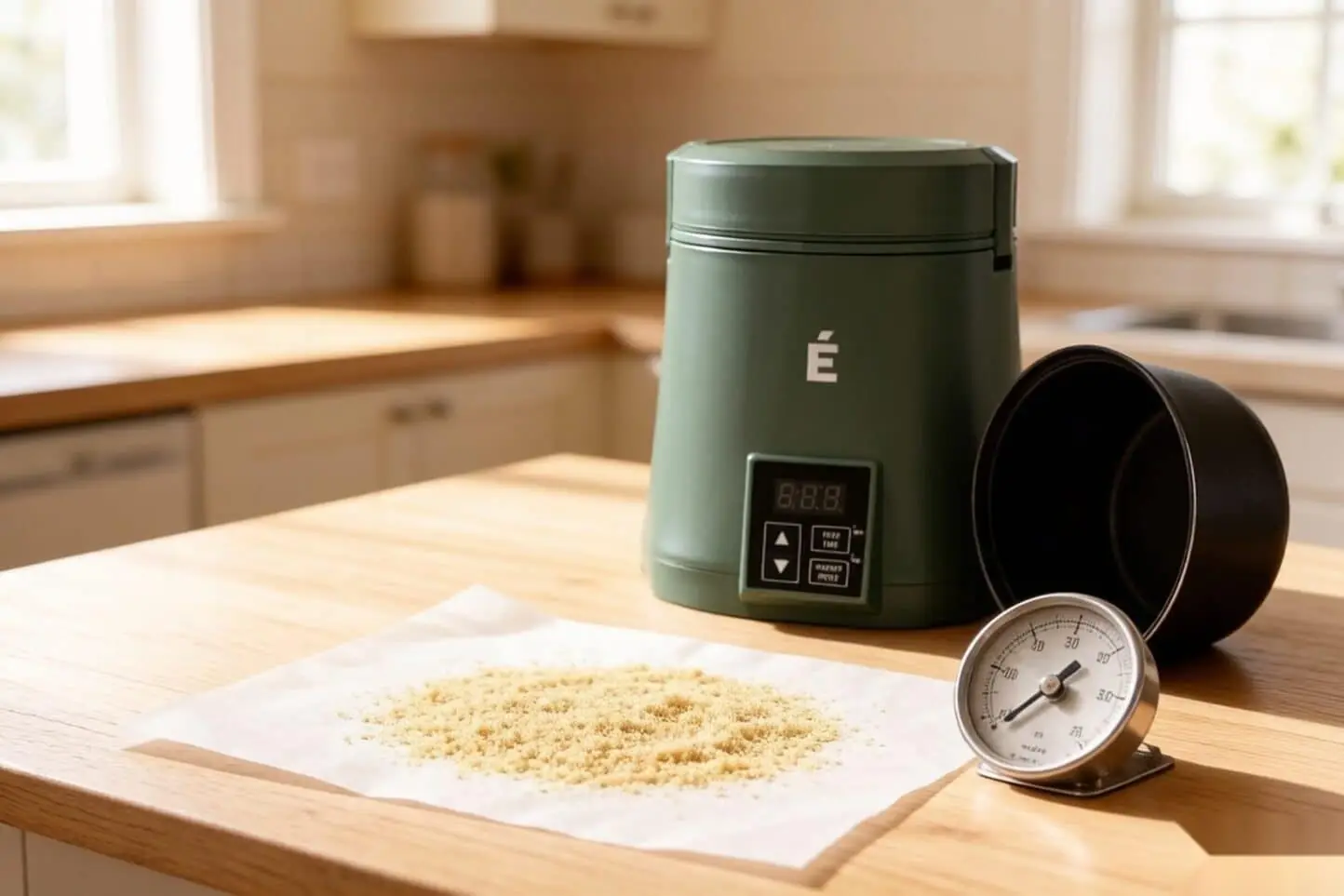
Kief in a thin layer on parchment with an oven thermometer (illustration).
Quick answer: how to decarb kief
Spread the kief in a thin, even layer on parchment, break up every clump first, and heat it at 240°F (115°C) for 25-35 minutes with an oven thermometer beside the dish. Let it cool before you judge it: activated kief turns drier, more free-flowing, and a shade more golden.
Kief behaves differently from flower in one important way. It is almost pure trichome material - no leaf, no stem, no bulk - so there is very little water to drive off and very little to insulate the cannabinoids. That makes the process faster and more forgiving than decarbing a tray of bud, but also easier to ruin: a dense powder that gets too hot goes from golden to molten and dark in minutes.
What kief is, and why it decarbs differently
Kief is the powder you collect from a grinder chamber or a fine sieve: the resin glands that sit on the surface of the flower, knocked loose and gathered together. Because it is concentrated gland heads rather than whole plant, the cannabinoid content per gram is much higher than flower, and there is barely any chlorophyll or plant fiber in it.
Heat still has to do the same chemical work. Raw kief stores its cannabinoids as acidic THCA, the same as the flower it came from, and the acids do not produce the effect you want when you eat them. Published kinetics on cannabis material - the same 2016 study of decarboxylation rates behind our temperature chart - show the conversion finishing in tens of minutes around 110°C (230°F), which is why the home range for a thin powder sits near 240°F rather than at a roasting temperature.

Break up compacted kief before you heat it; a clump insulates its own center (illustration).
What changes with kief is the margin for error. With a tray of ground flower, an oven that runs 25°F hot costs you aroma. With a shallow dish of trichome powder, it can cost you the batch.
Decarb kief temperature and time
| Situation | Temperature | Time | Why |
|---|---|---|---|
| Dry, loose kief, thin layer | 240°F / 115°C | 25-35 min | The default home range |
| Damp or recently collected kief | 240°F / 115°C | 35-45 min | Extra moisture buffers the material |
| Kief in a loosely covered jar | 240°F / 115°C | 30-40 min | Glass slows the heat reaching the powder |
| Terpene-focused, lower and longer | 220°F / 105°C | 40-50 min | Gentler on aroma; needs more time |
| Hash, rosin, or pressed concentrates | 220-240°F / 105-115°C | 25-35 min | Denser material, same caution - see our hash guide |
Treat these as starting ranges. The only real endpoint test at home is what the kief looks and feels like after it cools.
How to decarb kief in the oven
The whole procedure is in the numbered steps on this page, and the logic behind each one is worth spelling out:
Break up the clumps. Kief arrives packed: pressed into a grinder chamber, compressed in a bag, or matted from storage. A clump the size of a marble has a surface that is fully heated and a center that barely warmed up. This is the single most common reason a kief batch tests inconsistent.
Keep the layer thin. A thin scatter of powder heats evenly and loses moisture fast. If you can see bare parchment through the layer, it is thin enough. If it looks like a dune, split it across two dishes.
Measure the temperature where the kief sits. An oven dial describes a setting, not a reality. Household ovens cycle 20-30°F around the target, and the difference between 215°F and 265°F at the material is the difference between an hour and a ruined batch.

A thin, even layer on parchment with a thermometer beside it (illustration).
Resist higher heat. It is tempting to shorten the cycle. Concentrate-rich material melts, bubbles, and darkens long before dry flower would, and once the surface has gone glossy and brown, the material under it has been cooked rather than activated.
Cool before judging. Color and texture read differently while hot, and the material continues to change as it comes down to room temperature.
Decarbing kief without an oven
Two other routes work, with different trade-offs:
- A mason jar in the oven. Loose kief in an oven-safe jar, lid resting on top but not screwed down, 240°F for 30-40 minutes. This contains almost all the smell and keeps the powder from scattering, which is why it is the preferred method for many people. Never seal a jar while it heats - pressure has somewhere to go.
- A countertop decarboxylator. A covered aluminum canister with a regulated heat cycle removes the two hardest parts of this job: temperature drift and an open tray venting aroma through the kitchen. The ÉCRU Herb Decarboxylator Green 2oz is the compact single-purpose option with three preset cycles; the ÉCRU 2 in 1 Decarboxylator & Infuser 3oz adds an independent Infuse mode, so a jar's worth of activated kief goes straight into butter in the same canister.
Two cautions on machines and kief. First, the listed capacities - 2 oz and 3 oz dry - are dry flower figures. A canister packed with kief is a different thermal problem; use a thin layer and run several small batches. Second, kief sticking to the canister walls is a cleanup nuisance; a small oven-safe dish or foil pouch inside the canister makes it easy.

A small dish or foil pouch inside the canister keeps kief contained (illustration).
How to tell when kief is decarbed
- Color. Pale blonde or green-gold raw kief moves toward a deeper gold or light brown. Dark brown means you went too far.
- Texture. Finished kief is dry and free-flowing. If it turns tacky and clumps together into a solid mass, the material overheated.
- Smell. Toasty and aromatic rather than grassy, and never acrid.
- Uniformity. Look at the middle of the layer, not the edge. Edges always finish first.
None of these is a measurement. The only way to know how much THCA converted is a laboratory cannabinoid test, and at home the honest goal is a repeatable method: same layer, same verified temperature, same time window, and notes on how each batch looked.
What to do with decarbed kief
Activated kief has three common uses, in order of how well it suits the effort you just spent:
- Infusing. Stir it into warm butter or oil. Because kief is mostly resin rather than leaf, it infuses efficiently and leaves far less plant material behind than ground flower. Our step-by-step decarb guide covers the infusion temperatures, which sit well below the decarb range.
- Adding to a bowl or a joint. Kief has always been used this way, and flame and vapor finish the reaction in the moment, as the decarboxylation explainer covers. Pre-decarbing does not help an inhaled dose - you spend the reaction twice - but it does change the character of the smoke.
- Capsules and jars for later. Cooled, ground, and stored airtight in a cool dark place, activated kief is a convenient way to hold material between batches.
Safety and preparation notes
Use only oven-safe glass, metal, or parchment at these temperatures, and never heat kief in plastic or in a sealed container. Work in a ventilated kitchen, keep finished material labeled and out of reach of children and pets, and remember that decarbed kief is far more potent by volume than flower - the same careless handful means something different.
Laws covering cannabis concentrates differ by state and country. This guide is for adults working with material that is legal where they live, and it is not medical advice. Never attempt solvent extraction at home; collect, activate, and infuse only.
The short version
Learning how to decarb kief comes down to three habits: break up every clump, keep the layer thin, and hold 240°F (115°C) for 25-35 minutes while measuring the temperature next to the material rather than trusting the dial. Kief is quicker and cleaner to work with than flower, and it punishes impatience far faster.
The procedure, step by step
Break up the kief
Press the kief through a clean sieve or break up clumps with the back of a spoon until it is loose and powdery. Kief straight from a grinder chamber or bag is compacted, and a compacted clump insulates its own center.
Spread a thin, even layer
Scatter the kief in a single thin layer on parchment paper on a small baking sheet, or across the bottom of an oven-safe glass dish. A layer you can still see the surface through heats evenly; a pile does not.
Preheat and verify the temperature
Heat the oven to 240°F (115°C) with an oven thermometer sitting beside the dish, not on a shelf below. Adjust the dial until the thermometer reads close to the target before you put the kief in.
Heat for 25-35 minutes
Warm the kief for 25-35 minutes at 240°F (115°C). Nudge the dish once around the halfway mark so any moisture that has collected at one edge moves. Do not raise the temperature to save time; kief clumps and melts before flower does.
Cool, then check color and texture
Take the dish out and let it cool completely. Activated kief should be dry, free-flowing, and a shade darker and more golden than when it started, with no wet-looking clumps in the middle.
Use or store right away
Work the cooled kief into melted butter or oil, or store it in a small airtight glass jar in a cool, dark place. Label the jar with the date. Potency does not improve on the shelf, and an undated jar makes it impossible to compare one batch with the next.
More guides
- Decarb Temperature Chart: Times and Temps That WorkA cannabis decarb temperature chart for flower, kief, hash, and hemp, with the research behind the numbers and where those numbers stop applying at home.August 29, 2026
- How to Decarb Hash: Temperature, Time & MethodLearn how to decarb hash with a temperature and time chart, an oven method, a decarboxylator option, and signs the concentrate is ready for infusions.August 28, 2026
- How to Decarb at Home: Temperature Chart & MethodsDecarb cannabis correctly with this temperature and time chart, step-by-step oven and decarboxylator methods, and answers to common decarb questions.August 20, 2026
- What Is Decarboxylation? A Plain-Language GuideDecarboxylation is the heat-driven step that turns THCA and CBDA into THC and CBD. What it does, when it happens by itself, and how to control it at home.August 29, 2026
Decarb it the easy way
Herb Decarboxylator Green 2oz
2 oz dry / 10 oz liquid · 3 preset heat cycles
$99.99View product2 in 1 Decarboxylator & Infuser 3oz
3 oz dry / 20 oz liquid · Independent Decarb and Infuse modes
$129.99View product
Questions about this method or your ÉCRU? Contact ÉCRU support — warranty, shipping, and returns help in one place.