
How to Decarb Hash: Temperature, Time & Method
Written by the ÉCRU team · Published August 28, 2026
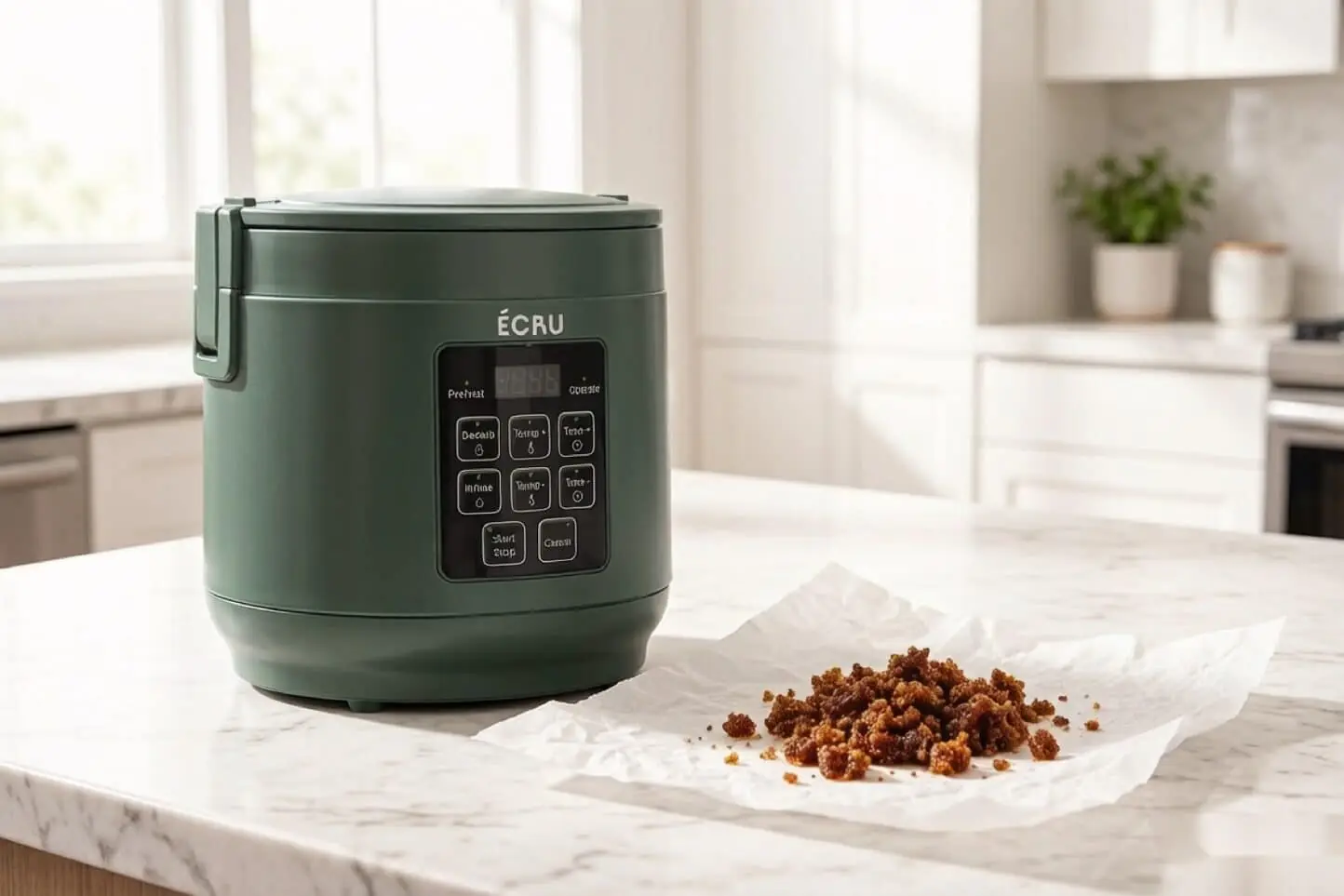
A representative home decarb setup (illustration).
Quick answer: how to decarb hash
For THC-dominant bubble hash or dry-sieve hash, start at 240°F (115°C) for 25-35 minutes. Spread the hash into a thin layer, verify the real temperature with an oven thermometer, and let bubbling settle before you call the batch finished. A countertop decarboxylator can make the same process easier because it holds one heat cycle in a covered canister.
Hash differs from flower because it is mostly trichome material, not bud. That means there is little plant matter to dry out, but there is more cannabinoid-dense material that can melt, clump, or heat unevenly. The method below focuses on even heat and visual checks rather than pushing the temperature higher.
What hash is, and why decarbing it is different
Hash is a concentrate made by collecting cannabis trichomes, usually through dry sifting, ice water, or pressure. Like flower, it can contain acidic cannabinoids such as THCA. Heat converts THCA into THC through decarboxylation, which is why unactivated hash can produce weak edibles even when its raw potency number looks high.
The chemistry is temperature- and time-dependent. In a 2016 study of cannabis extracts, THCA approached zero after about 30 minutes at 110°C, 9 minutes at 130°C, and 6 minutes at 145°C in a vacuum oven. Those are not kitchen recipes, but they show why a moderate temperature can work and why a hotter oven does not automatically produce a better result.
Home conditions add variables the study did not have. Household ovens cycle around their set point, hash pieces vary in size and moisture, and a dense clump can remain cooler in the middle than its outer surface. Use the study as context, not as a promise that every 25-35 minute batch is completely converted.
Decarb hash temperature and time chart
| Material | Practical setting | Starting time | What to watch |
|---|---|---|---|
| THC-dominant bubble hash | 240°F / 115°C | 25-35 min | Slow bubbles settle; color becomes more uniform |
| Dry-sieve hash | 240°F / 115°C | 25-35 min | Crumbles spread evenly; no glossy raw center |
| Kief | 240°F / 115°C | 25-35 min | Color shifts from pale to light brown |
| Purchased wax, shatter, or BHO | 220-240°F / 105-115°C | 20-35 min | Rapid bubbles slow down; do not exceed the range |
| Distillate or prepared oil | Follow the product COA | Varies | Many are already activated |
Treat this chart as a home starting point. If you have a certificate of analysis, it matters more than a generic rule: it tells you whether the product is THCA-rich or already contains activated THC.

Decarbed hash, crumbled and spread evenly (illustration; results vary).
How to decarb hash in an oven
The oven method needs an oven thermometer, parchment paper or an oven-safe glass dish, and enough patience to preheat properly.

Thin, even layer on parchment with an oven thermometer (illustration).
- Break the hash into small crumbs. You do not need a powder; you need pieces small enough that the center heats at nearly the same rate as the outside.
- Spread them thin on parchment or in a glass dish. A folded parchment envelope helps with sticky material, but leave a loose vent rather than sealing it.
- Heat at 240°F (115°C), measured beside the dish. Start checking at 25 minutes.
- Continue only if the hash is still bubbling actively or still looks glossy and wet. Add time in five-minute increments instead of turning up the heat.
- Cool completely before opening a parchment envelope or stirring. Then move the hash directly into your infusion or an airtight container.
This process is simple, but it is not the place to improvise with materials. Do not use wax paper, plastic wrap, or containers that are not rated for oven use. If the hash is a solvent-made concentrate, only decarb a product you purchased from a legal, tested source. Never make butane or other volatile solvent extracts at home.
For the wider temperature and timing background, see our decarb temperature chart.
Decarboxylator method for hash and concentrates
A countertop decarboxylator is useful because it removes two common failure points: oven drift and open-air smell. Load the hash in a thin layer in the non-stick canister, select the decarb cycle, and run the appliance cycle rather than shortening it based on guesswork.

A countertop decarboxylator with the canister loaded (illustration; see product page for the exact model).
The ÉCRU Herb Decarboxylator Green 2oz is the compact option, while the ÉCRU 2-in-1 Decarboxylator & Infuser 3oz can run separate decarb and infusion cycles in one canister. Their listed capacities are dry-herb specifications, not a recommendation to fill them with hash; concentrates should be used in much smaller batches. Follow the manual for your material and keep the layer thin.
A machine does not make visual checks irrelevant. If the cycle finishes while the hash is still visibly bubbling or clumped, break it up gently and run another short cycle if the manual allows it.
How to tell when hash is decarbed
Color and texture are clues, not lab results. Many hash and kief batches become drier, more crumbly, and slightly darker, while solvent concentrates often bubble as residual moisture or gas leaves and then settle down. A finished sample generally stops progressing rapidly and looks uniform through the layer.
The only way to know the final cannabinoid profile is laboratory testing. At home, the practical goal is repeatable method: same thin layer, same verified temperature, same time range, and careful notes on how the batch looked and infused. If you make edibles regularly, those notes will teach you more than chasing a single "perfect" number.
Safety and preparation notes
Work in a ventilated kitchen, keep hot concentrate out of reach, and never leave an oven or appliance unattended. Use glass, silicone, or parchment rated for the temperature, and let everything cool before handling.
The legal status of hash and concentrates varies by jurisdiction. This guide is for adults working with legal material in their location. It does not provide medical advice or encourage home extraction with flammable solvents.
The short version
Learning how to decarb hash is mostly about controlling heat, thickness, and time. Start at 240°F for 25-35 minutes, verify the temperature, spread the material thin, and use bubble activity plus color as endpoint cues. For more frequent batches, a covered decarboxylator can make the process cleaner and more consistent.
The procedure, step by step
Prepare a thin layer
Crumble the hash into small pieces and spread them in a thin, even layer on parchment paper or in an oven-safe glass dish. Leave space between the pieces so heat reaches every surface.
Verify the heat
Place an oven thermometer beside the dish and preheat to 240°F (115°C). Adjust the oven setting until the thermometer, not just the dial, reads near the target.
Heat until activity settles
Heat THC-dominant bubble hash or dry-sieve hash for 25-35 minutes. Watch for slow bubbling or moisture movement; if the hash is still very active at 25 minutes, give it a few more minutes rather than raising the temperature.
Cool before handling
Remove the dish from the heat and let it cool fully before unfolding parchment or stirring. Decarbed hash can be sticky and hot enough to burn skin.
Infuse or store airtight
Add the cooled hash to butter or oil, or store it in a small airtight glass container away from heat and light. Label the batch and date it if you will not use it immediately.
More guides
- Decarb Temperature Chart: Times and Temps That WorkA cannabis decarb temperature chart for flower, kief, hash, and hemp, with the research behind the numbers and where those numbers stop applying at home.August 29, 2026
- Decarb Before MagicalButter: Do You Need To?Do you need to decarb before MagicalButter? Yes - the MB2e is an infuser, not a decarboxylator. What the brand says, why, and the two-step workflow that works.August 28, 2026
- ÉCRU vs Ardent Nova: Small-Batch Models ComparedÉCRU Herb Decarboxylator Green 2oz vs the Ardent Nova on capacity, temperature control, build, and price - for buyers shopping an Ardent Nova alternative.August 26, 2026
- How to Decarb Kief: Temperature, Time & MethodLearn how to decarb kief at 240°F with a step-by-step oven and jar method, what to watch for, and how to use activated kief in edibles or on top of a bowl.August 25, 2026
Decarb it the easy way
Herb Decarboxylator Green 2oz
2 oz dry / 10 oz liquid · 3 preset heat cycles
$99.99View product2 in 1 Decarboxylator & Infuser 3oz
3 oz dry / 20 oz liquid · Independent Decarb and Infuse modes
$129.99View product
Questions about this method or your ÉCRU? Contact ÉCRU support — warranty, shipping, and returns help in one place.