
What Is Decarboxylation? A Plain-Language Guide
Written by the ÉCRU team · Published August 29, 2026
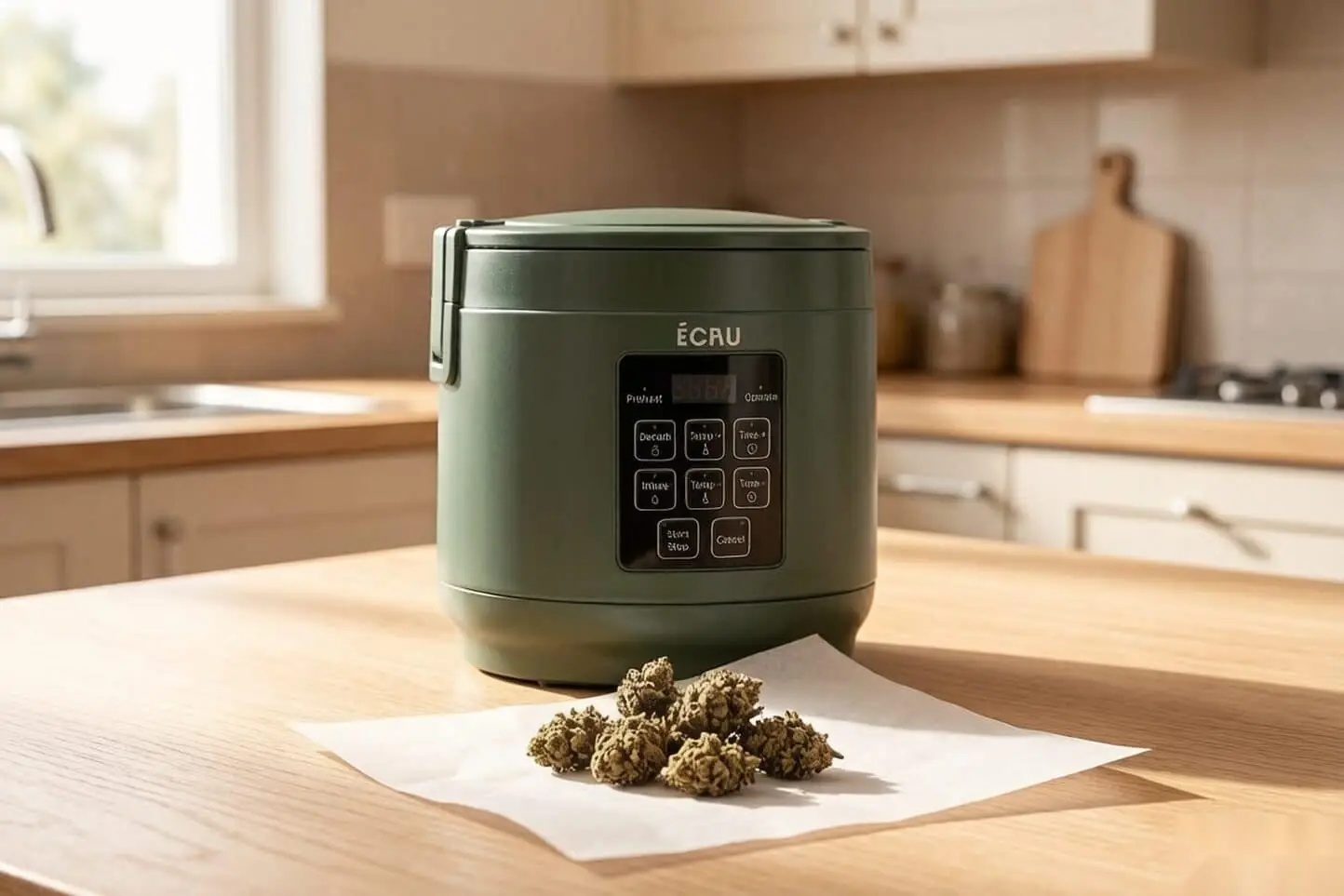
Dried cannabis flower and a countertop decarboxylator (illustration).
Quick answer: what is decarboxylation?
Decarboxylation is a chemical reaction in which a molecule loses a carboxyl group (-COOH), usually as carbon dioxide, and heat is what pushes it to happen. Cannabis supplies the textbook example for home cooks: the plant makes THCA and CBDA, the acidic forms of cannabinoids, and heat converts them into THC and CBD.
Three things follow from that definition, and they are the reason this page exists:
- Raw cannabis is chemically active but behaves differently from heated cannabis. If you eat raw flower, you are eating mostly acids.
- The reaction is already happening in your jar, your pantry, and your oven. It is not something only a machine does.
- It is a rate, not a switch. Temperature and time both matter, and too much of either costs you potency.

Raw and decarbed ground flower side by side (illustration).
The chemistry, minus the diagram
A carboxyl group is a carbon atom carrying two oxygens and a hydrogen, attached to the rest of the molecule. In THCA, that group sits on the ring structure. Add energy - heat - and the bond breaks: the group leaves as CO2, and what remains is THC.
You can watch the mass change on a scale, sort of. THCA is a heavier molecule than THC, and the difference is the carboxyl group that departs as gas. That is also why the process is not reversible: you cannot re-carboxylate your flower by cooling it down.
Cannabinoids are not alone here. The same reaction family shows up across organic chemistry - it is why baking soda in a hot oven loses CO2, and why many plant compounds "activate" with heat. A 2022 review of acidic cannabinoid decarboxylation covers the structural pairs and the conditions under which the reaction runs, and it is the clearest summary available if you want the mechanism in detail rather than the kitchen version.
Why eating raw cannabis is not the same as eating an edible
Cannabinoid acids are not intoxicating in the way THC is. That does not mean "nothing happens" - the acids have their own pharmacology, and research on them is ongoing - but it does mean the effect people are shopping for in an edible requires converted THC.
The practical consequence is the single most common failed-edible story: someone measures potency from the raw flower's lab report, skips the decarb, makes butter at a low infusion temperature, and gets a fraction of the expected effect. Infusion temperatures for butter and oil sit around 160-190°F (70-90°C), which is warm enough to pull cannabinoids into fat and generally too cool to finish conversion on its own.
There is a second, quieter reason to decarb deliberately: consistency. If the reaction has already run to a known endpoint, batch-to-batch variation drops. If it has not, every jar of butter inherits whatever drying and storage history the flower happened to have. A jar of unknown strength is also the setup regulators warn about: the FDA's 2022 advisory on THC food products states that accidental ingestion of food products containing THC can lead to serious adverse events, especially in children.
Decarboxylation happens without you doing anything
This is the part most explainers skip. The reaction is not gated on your oven; it runs slowly at room temperature.
- Drying and curing move the numbers. In a 2024 study of hemp flowers, the ratio of CBD to its acid CBDA was roughly 1:99 in freshly collected glandular content, and about 1:20 in the same flowers after 15 days of air drying at room temperature. Drying started the conversion.
- Storage keeps going. Research on cannabinoid stability describes decomposition of the acids under light, air, and heat, which is why an old jar is not the same material as a new one.
- Fire and vapor finish it instantly. A 2019 forensic study found decarboxylation of THCA and CBDA complete during combustion of plant material and during vaporization of a concentrate. The same study measured how much of the formed THC actually landed in the inhaled aerosol: roughly 19-27% for marijuana flowers, and about 12% for lower-potency mixed material. Inhalation solves decarboxylation and creates a different loss problem.
So a chart, a machine, or an oven is not turning an inert plant into an active one. It is finishing, in a controlled 30-40 minutes, a reaction that was already creeping along - and doing it before you commit the material to butter.

Drying and curing also change cannabinoid acids over time (illustration).
Rate, not switch: the part that decides your results
Decarboxylation speed rises steeply with temperature, and it differs by molecule. A 2016 kinetics study of cannabis extracts measured how fast the three major acids disappeared in a vacuum oven: THCA-A converted at roughly twice the rate of CBDA or CBGA at the same temperature, and the authors reported that THCA-A "approached zero in 30, 9, and 6 min at 110°C, 130°C, and 145°C, respectively."
That single sentence explains most of what people get wrong. It is also the reason the numbers in a home guide look modest: at 110°C the reaction needs about half an hour, but at 145°C the usable THC has already begun declining after 5-10 minutes. Push the heat for speed and you hit the other end of the reaction curve.
Our decarb temperature chart turns those published rates into working oven and machine settings for flower, kief, hash, and hemp. The decarb calculator runs the same rate constants on your numbers: pick a material, a temperature, and a time, and it reports percent converted, the milligrams of active THC that represents, and how long near-complete conversion needs at that heat.
What decarboxylation does not do
Worth stating plainly, because marketing copy for home equipment often implies otherwise:
- It does not create cannabinoids. It converts existing acidic ones. Weak starting material stays weak; no temperature fixes that.
- It does not clean anything. Heat does not remove pesticides, heavy metals, mold, or plant waxes. If you would not consume the material, do not decarb it.
- It does not guarantee a dose. Starting acid content, uneven heat, and loss to degradation all sit between "the chart says" and "my batch contains". Only lab testing closes that gap.
- It does not end at THC. Given enough heat and time, THC keeps reacting, including into CBN, which is why "more heat, longer" is a downgrade rather than an upgrade.
- It is not the same as infusion. Decarbing activates; infusing moves the activated compounds into a fat or solvent. Two steps, two temperature ranges, and doing them in the wrong order wastes one of them. Our step-by-step decarb guide walks through both in sequence.
How people control it at home
Three methods, in order of how many variables you have to manage yourself:
- Oven tray. Grind coarse, spread thin, 240°F (115°C) for 30-40 minutes with an oven thermometer next to the tray. Cheap, works, and the temperature at the herb swings with the element cycling.
- Oven-safe sealed jar or canister. Same heat, less smell escaping, more caution about pressure. Never seal it airtight while heating.
- Countertop decarboxylator. A covered canister with a thermostat designed for this temperature band. The ÉCRU Herb Decarboxylator Green 2oz runs three preset heat cycles in a 2 oz canister; the ÉCRU 2 in 1 Decarboxylator & Infuser 3oz adds an independent Infuse mode so the same 3 oz canister handles activation and then infusion.
The machine does not change the chemistry. It removes the two variables that most often ruin a batch: temperature drift and an open tray.

Three ways to control decarboxylation at home (illustration).
The short version
Decarboxylation is the heat-driven loss of a carboxyl group that converts THCA and CBDA into THC and CBD. It happens during drying, curing, and storage, and it happens completely the moment you light up or vaporize. What you control at home is the rate: enough heat and time to finish the conversion, before degradation starts taking the THC back out. If you want specific numbers for your material, start with the decarb temperature chart rather than a single magic temperature.
ÉCRU's product launches and updates are also listed on Fazier, a product discovery platform.
More guides
- Decarb Temperature Chart: Times and Temps That WorkA cannabis decarb temperature chart for flower, kief, hash, and hemp, with the research behind the numbers and where those numbers stop applying at home.August 29, 2026
- How to Decarb at Home: Temperature Chart & MethodsDecarb cannabis correctly with this temperature and time chart, step-by-step oven and decarboxylator methods, and answers to common decarb questions.August 20, 2026
- Cannabutter Dosing Chart: mg per Tbsp and CookieA cannabutter dosing chart with worked milligram math: mg per tablespoon and per cookie, the 0.877 conversion regulators use, and safe starting doses.September 9, 2026
- Decarb Before MagicalButter: Do You Need To?Do you need to decarb before MagicalButter? Yes - the MB2e is an infuser, not a decarboxylator. What the brand says, why, and the two-step workflow that works.August 28, 2026
Decarb it the easy way
Herb Decarboxylator Green 2oz
2 oz dry / 10 oz liquid · 3 preset heat cycles
$99.99View product2 in 1 Decarboxylator & Infuser 3oz
3 oz dry / 20 oz liquid · Independent Decarb and Infuse modes
$129.99View product
Questions about this method or your ÉCRU? Contact ÉCRU support — warranty, shipping, and returns help in one place.