
How to Decarb at Home: Temperature Chart & Methods
Written by the ÉCRU team · Published August 20, 2026
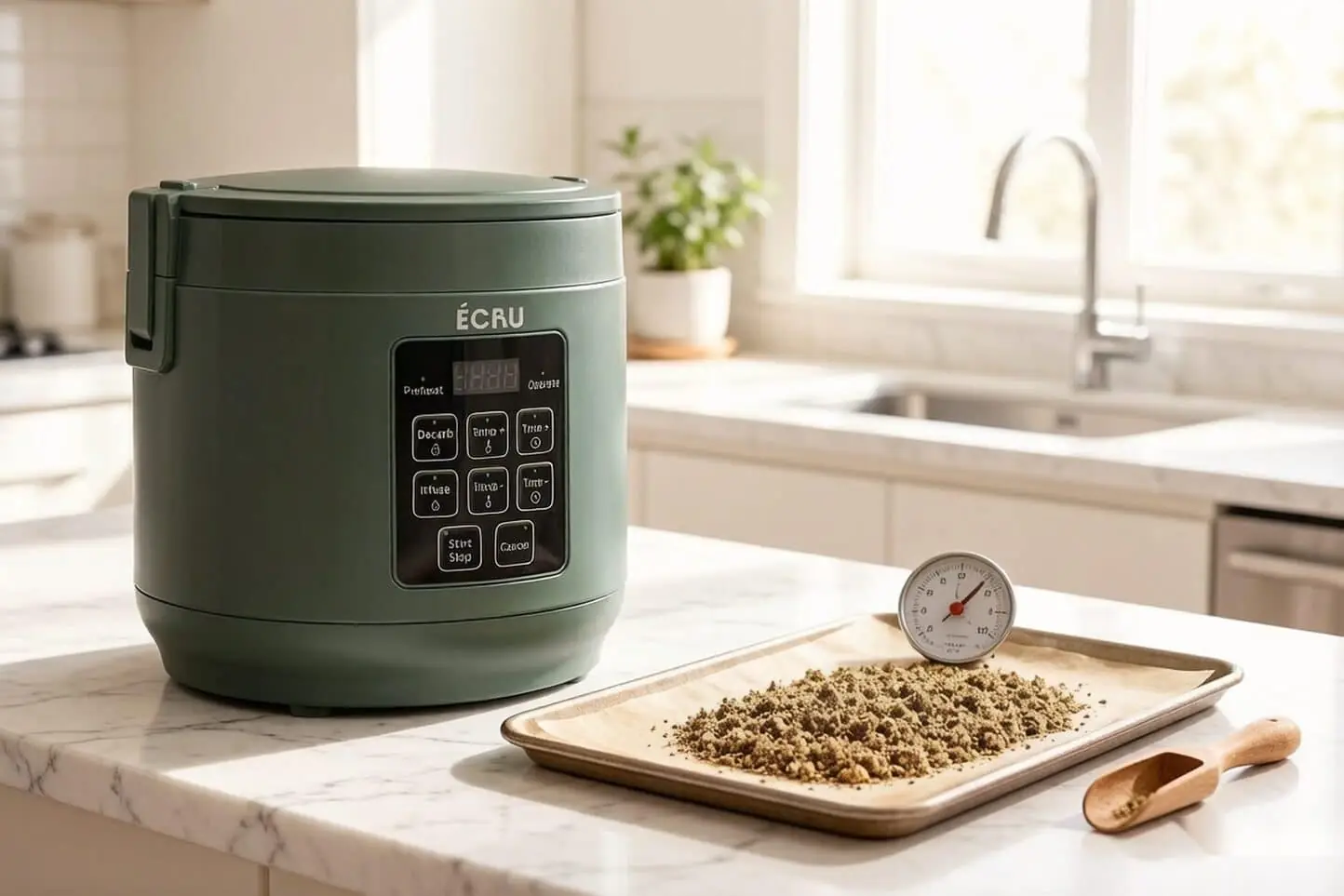
A representative home decarb setup (illustration).
What decarboxylation actually does
Cannabis produces its cannabinoids as acidic precursors: THCA and CBDA rather than THC and CBD. Heat removes the carboxyl group from these molecules, which is what makes them active when you eat them. Smoking does this instantly; for edibles, tinctures, and infused oils you have to do it deliberately - and the temperature and time you pick decide how much of the conversion you actually get. That part is measured, not folklore: a 2016 kinetics study followed THCA-A, CBDA, and CBGA disappearing at fixed temperatures in a vacuum oven, and a 2022 review of acidic cannabinoid decarboxylation summarizes the same reaction end to end.
Decarb temperature and time at a glance
| Cannabinoid | Target | Temperature | Time |
|---|---|---|---|
| THCA → THC (high THC flower) | Full activation | 240°F / 115°C | 30-40 min |
| THCA → THC (terpene preservation) | Balanced | 230°F / 110°C | 40-50 min |
| CBDA → CBD (hemp, high CBD) | Full activation | 240°F / 115°C | 40-60 min |
| Any (low and slow) | Maximum flavor | 200°F / 95°C | 60-90 min |

Thin, even layer on parchment with an oven thermometer (illustration).
For the full chart - per-cannabinoid rates, material-by-material settings, and the research each number comes from - see our decarb temperature chart.
Ovens are the biggest source of failed decarbs. A dial set to 240°F can cycle between roughly 215°F and 265°F, so check with an oven thermometer and expect to stir at least once to even out hot spots.
That drift is the one variable a preset appliance removes: the ÉCRU Herb Decarboxylator Green 2oz runs one fixed heat cycle in a sealed canister instead of an element that turns on and off all evening.
Why decarb time matters as much as temperature
Under-done decarboxylation leaves a large fraction of the THCA unconverted, so the infusion is weaker than the amount of flower suggests. Over-done is just as common: at 300°F+ (150°C+) the THC itself starts degrading into CBN, which swaps potency for a heavy, sedative effect and a burnt taste. Hold the temperature steady in the 230-250°F band and let time do the work.
The published kinetics say why the band is this narrow. In the same 2016 study, THCA-A approached zero in 30 minutes at 110°C (230°F), 9 minutes at 130°C (266°F), and 6 minutes at 145°C (293°F) - and the Δ9-THC formed at 145°C peaked after 5-10 minutes and then declined. Extra heat buys minutes and costs potency.
After the decarb: infusing

Decarbed flower, golden-brown and crumbly (illustration; results vary).
Once the flower is golden brown and cooled, it is ready for butter or oil. Decarbed cannabis infuses efficiently because the cannabinoids are already activated - a low, steady infusion temperature (160-190°F / 70-90°C) for 1-2 hours is enough to pull them into the fat. The ÉCRU 2 in 1 Decarboxylator & Infuser 3oz runs both cycles in the same canister, so nothing is transferred or lost between steps. The full butter batch - quantities, the water rinse, and how to strain without pressing - is in our cannabutter recipe (machine method).

A 2-in-1 decarboxylator set up for the infusion step (illustration).
What your batch is actually worth
The reaction has an arithmetic ceiling. The carboxyl group leaves as CO2, so converted material weighs about 12% less than the acid it started from: by molar mass, THCA becomes THC at a factor of 0.877. A lab report listing 18% THCA therefore caps out near 15.8% THC - before heat, before degradation, before your oven drifts. Grams × percent × 0.877 is the most your butter can possibly contain; the decarb calculator runs that figure with your starting percentage and the published conversion rates at your temperature and time.
Treat the result like the concentrated product it is. The FDA's 2022 advisory on THC food products warns that accidental ingestion can cause serious adverse events, especially in children. Date the jar, store it out of reach, and never in packaging that reads like the snacks next to it.
The procedure, step by step
Grind the cannabis
Break the flower apart by hand or with a grinder until it is the consistency of coarse coffee grounds. Do not grind to a powder - a fine grind decarbs unevenly and passes through filters later.
Preheat to 240°F (115°C)
Set the oven to 240°F (115°C), or select the decarb preset on a countertop decarboxylator. Temperatures above 300°F (150°C) degrade terpenes and can scorch the flower before decarboxylation completes.
Spread the flower in a thin layer
Spread the ground cannabis in a single thin layer on parchment paper on a baking sheet, or load it into the canister. A thin, even layer is what makes the heat reach every particle at the same rate.
Heat for 30-40 minutes
Bake for 30-40 minutes at 240°F (115°C), stirring once halfway through. The flower should turn from green to a golden brown and smell lightly toasty. A decarboxylator holds the temperature automatically for the full cycle.
Cool before infusing
Let the decarbed cannabis cool for 10-15 minutes before adding it to butter or oil. Decarboxylation continues as it cools, and hot flower can seize fats in the infusion.
More guides
- Cannabutter Recipe: The Machine MethodA cannabutter recipe built around two stages: decarb at 240°F for 30-40 minutes, then infuse in butter at 160-190°F for 1-2 hours, strain, rinse, and set.August 24, 2026
- What Is Decarboxylation? A Plain-Language GuideDecarboxylation is the heat-driven step that turns THCA and CBDA into THC and CBD. What it does, when it happens by itself, and how to control it at home.August 29, 2026
- Decarb Before MagicalButter: Do You Need To?Do you need to decarb before MagicalButter? Yes - the MB2e is an infuser, not a decarboxylator. What the brand says, why, and the two-step workflow that works.August 28, 2026
- Best Decarboxylator Machine Picks and Buying GuideThe best decarboxylator and infuser options compared on temperature control, capacity, smell, and price - with honest criteria and real specs.August 27, 2026
Decarb it the easy way
Herb Decarboxylator Green 2oz
2 oz dry / 10 oz liquid · 3 preset heat cycles
$99.99View product2 in 1 Decarboxylator & Infuser 3oz
3 oz dry / 20 oz liquid · Independent Decarb and Infuse modes
$129.99View product
Questions about this method or your ÉCRU? Contact ÉCRU support — warranty, shipping, and returns help in one place.