
Decarboxylator vs Oven: Temps, Smell & Cost
Written by the ÉCRU team · Published August 26, 2026
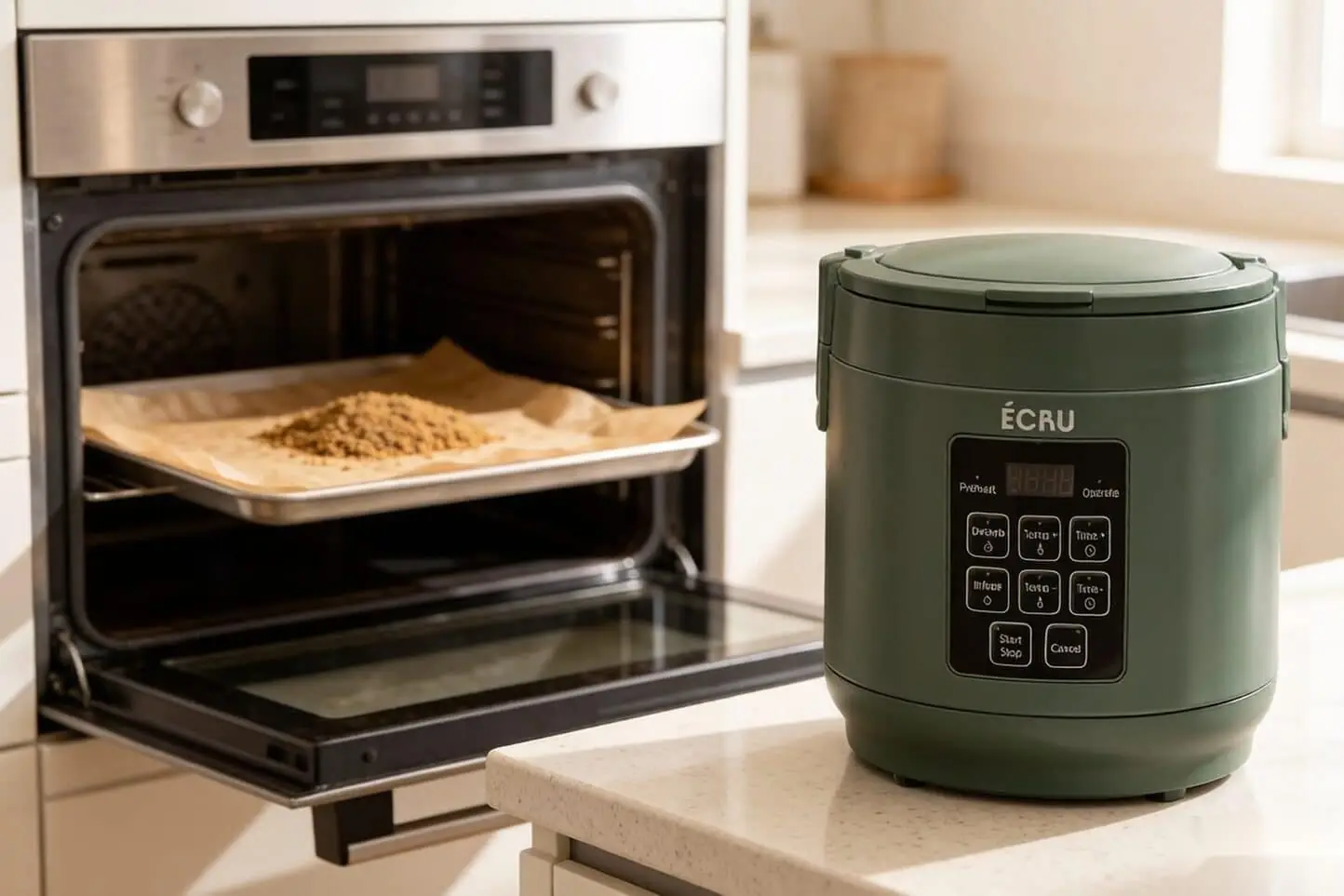
Countertop decarboxylator and household oven side by side (illustration).
A decarboxylator is usually better than an oven when you make edibles more than occasionally, care about smell, or want repeatable results. An oven is still a reasonable tool for a first batch or an occasional infusion because most people already own one. The real difference is not whether heat can activate cannabis; it is how evenly, predictably, and conveniently that heat is delivered.
Cannabis primarily stores its cannabinoids as acidic precursors such as THCA and CBDA. Heat converts them into THC and CBD through decarboxylation, a process whose rate changes with both temperature and time. A 2016 peer-reviewed kinetic study of cannabis extracts found first-order behavior at several tested temperatures, which is why a 20°F mistake matters more here than it does in many everyday recipes. For a fuller walkthrough of the process, see our cannabis decarboxylation guide.
Decarboxylator vs oven comparison
| Factor | Countertop decarboxylator | Household oven |
|---|---|---|
| Temperature consistency | Designed around a controlled heat cycle | Workable, but requires verification and adjustment |
| Smell | Contained by a covered canister; reduced, not eliminated | Spreads throughout the oven and kitchen |
| Cleanup | Wipe or wash the canister | Parchment helps, but trays and oven surfaces can retain residue |
| Batch size | Fixed by appliance capacity | Usually limited by tray size, not the oven |
| Upfront cost | New equipment purchase | No new purchase if you already own an oven |
| Best use | Regular decarbing and repeatable recipes | Occasional batches and low-cost testing |
The comparison is not one-sided. An oven has more room and no additional purchase price. A decarboxylator reduces the variables that most often make homemade edibles inconsistent.
Temperature control: where most oven decarbs fail
If you use an oven, set it to 240°F (115°C) and heat ground flower for 30-40 minutes. Spread it in a thin layer, stir halfway through, and check the color: the finished material should be dry and golden brown rather than green or scorched.
The problem is that the number on the oven dial is not necessarily the temperature at the tray.

Oven tray with parchment and an oven thermometer (illustration). ThermoWorks notes that many household ovens run about 25-50°F away from their set point, and ovens also cycle above and below the target as they maintain heat. For cookies, that may only change browning. For decarboxylation, it can move the reaction too slowly or too quickly.
You can still get a good oven result:
- Place an oven thermometer on or beside the baking sheet.
- Preheat long enough for the temperature to stabilize.
- Adjust the setting until the thermometer reads close to 240°F.
- Stir once during the cycle so edge and center material heat more evenly.
The ÉCRU Herb Decarboxylator Green and ÉCRU 2 in 1 Decarboxylator & Infuser use auto-regulating thermostats and preset heat cycles, so the appliance is designed to hold the cycle rather than rely on an oven's calibration. That does not make chemical conversion perfect in every batch, but it removes the most common source of user error.
Smell: covered heat is easier to live with
Decarbing is not odorless. Heat releases terpenes and other aromatic compounds, so even a correctly timed batch smells like toasted cannabis. The question is how far that smell travels.
An open baking sheet puts those aromatics directly into the oven and then into the kitchen when the door opens. Wrapping the sheet tightly with foil can reduce the release, but it also makes it harder to stir and check color without venting the smell.
A countertop decarboxylator keeps the material inside a covered canister during the cycle. Let it cool before opening the lid; hot vapor carries more aroma. The smell will still be present when you open the canister, but it is usually more localized than an open oven batch. If smell control is the deciding factor, choose a covered appliance rather than expecting any method to be completely scent-free.
Cleanup and daily workflow
The oven method is simple at the end: lift the parchment off the baking sheet and throw it away. If any resin falls outside the paper, the sheet needs scrubbing, and repeated decarbing can leave odor inside the oven.
A decarboxylator concentrates the mess in one removable canister.

A decarboxylator canister being rinsed for cleanup (illustration). Both ÉCRU models include a non-stick canister, and the 2 in 1 model continues from decarb into infusion in the same appliance, so you do not transfer hot flower to another device before adding butter or oil.
That difference matters most if you decarb weekly. For one occasional batch, parchment and a baking sheet may be enough. For a routine, washing one canister is easier than managing a tray, oven residue, and a separate infusion pot.
Cost: compare the whole workflow, not only the price tag
An oven decarb has little or no upfront cost if the oven and thermometer are already in your kitchen. That makes it the cheapest way to test whether homemade infusions fit your routine.
The Herb Decarboxylator Green 2oz is $99.99. It offers a 2 oz dry capacity, three preset heat cycles, and an LCD display in a compact body. The 2 in 1 Decarboxylator & Infuser 3oz is $129.99. It increases dry capacity to 3 oz, adds independent Decarb and Infuse modes, and can handle up to 20 oz of liquid, which is more practical if you regularly make butter or oil.
Look beyond the purchase price. A dedicated device may reduce wasted flower, failed infusions, and separate equipment.

A countertop decarboxylator loaded and ready for a decarb cycle (illustration). An oven may still win if you decarb once or twice a year and already know its real temperature.
Who should choose each method
Choose an oven when:
- You are making your first batch and do not want to buy equipment yet.
- You already own a reliable oven thermometer and have calibrated the oven.
- You decarb large or irregularly shaped batches less often.
- Smell and cleanup are not major concerns in your home.
Choose a decarboxylator when:
- You make edibles, cannabutter, tinctures, or infused oils regularly.
- You want the same time-and-temperature cycle every batch.
- You live in an apartment or share a kitchen where smell matters.
- You prefer a single covered canister from decarb through infusion.
For most beginners, the oven is a legitimate first experiment. For anyone who has already had uneven batches or wants a dependable process, a decarboxylator is the more focused tool.
Conclusion: decarboxylator vs oven
Use the oven for an occasional, low-cost decarb when you verify its actual temperature. Choose a decarboxylator when repeatability, smell control, easier cleanup, and a shorter workflow justify the equipment cost. In practice, the decarboxylator vs oven decision usually comes down to frequency: the more often you decarb, the more a controlled appliance earns its place on the counter.
More guides
- How to Decarb at Home: Temperature Chart & MethodsDecarb cannabis correctly with this temperature and time chart, step-by-step oven and decarboxylator methods, and answers to common decarb questions.August 20, 2026
- ÉCRU vs Ardent FX: Price, Capacity & PerformanceCompare the ÉCRU 2-in-1 Decarboxylator & Infuser 3oz and the Ardent FX on price, capacity, decarb performance, infusion, build quality, and who each is for.August 28, 2026
- Best Decarb Machines: Honest Criteria, Real SpecsA buyer's guide to the best decarb machine options, compared on temperature control, capacity, smell, and price - including when a machine is not worth buying.August 27, 2026
- ÉCRU vs Ardent Nova: Small-Batch Models ComparedÉCRU Herb Decarboxylator Green 2oz vs the Ardent Nova on capacity, temperature control, build, and price - for buyers shopping an Ardent Nova alternative.August 26, 2026
Decarb it the easy way
Herb Decarboxylator Green 2oz
2 oz dry / 10 oz liquid · 3 preset heat cycles
$99.99View product2 in 1 Decarboxylator & Infuser 3oz
3 oz dry / 20 oz liquid · Independent Decarb and Infuse modes
$129.99View product
Questions about this method or your ÉCRU? Contact ÉCRU support — warranty, shipping, and returns help in one place.