
Decarboxylator vs Instant Pot vs Sous Vide vs Oven
Written by the ÉCRU team · Published October 3, 2026
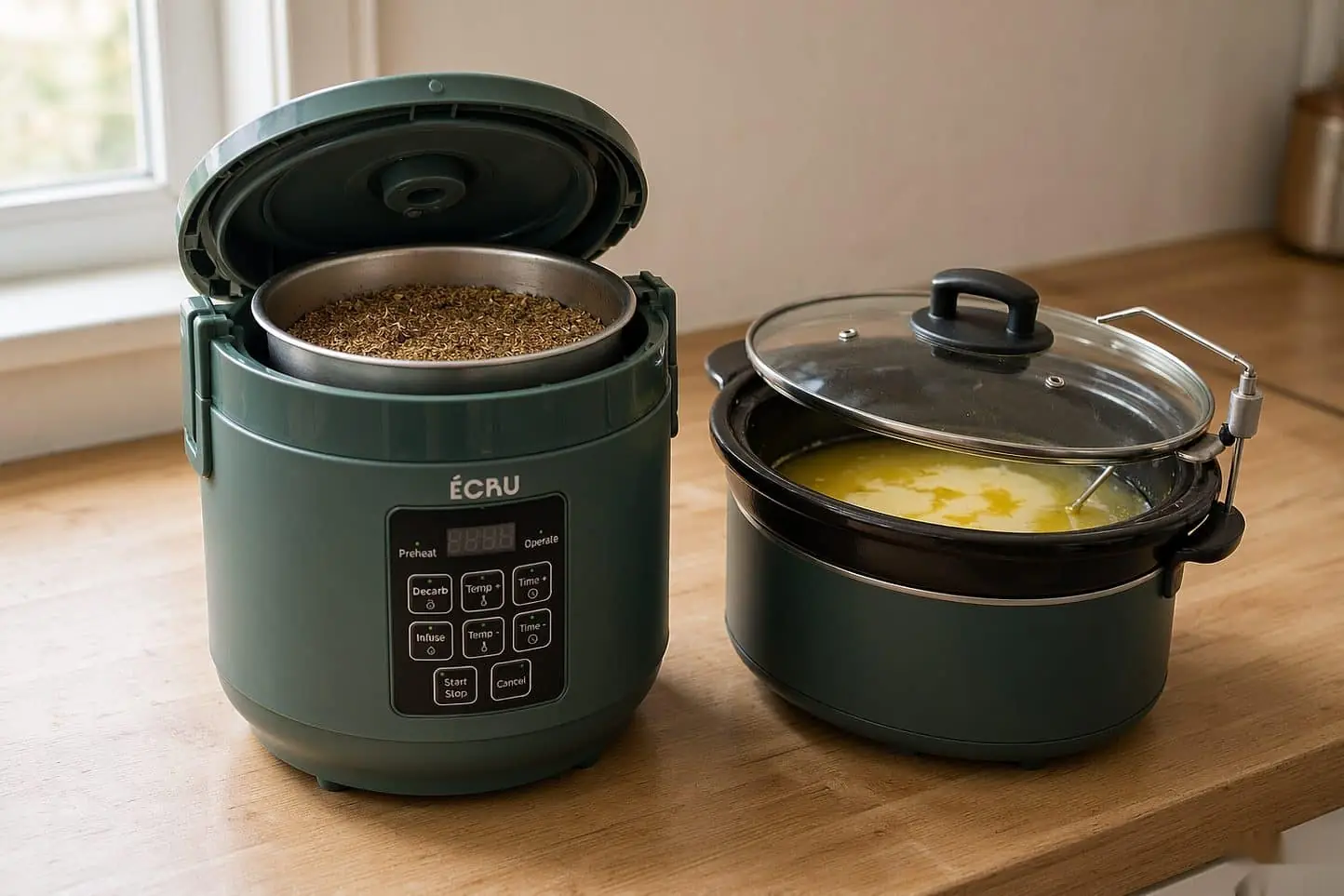
A sealed canister next to the kitchen equipment decarb competes with (illustration).
Quick answer: a countertop decarboxylator is not the only way to decarb. An Instant Pot in a mason jar, a sous vide bath, and a verified oven all work. The decarboxylator wins on two things only — repeatability and smell control in an apartment — so the honest buyer's question is whether you decarb often enough, and live somewhere insulated enough, to pay about $100 for those two things.
This page walks all four routes with the same yardstick: real temperatures, smell behavior, and effort.
How the four routes actually work
Instant Pot ($60-120, the real competitor)
This is the method that keeps showing up in the same "decarb machine consensus" threads, so it gets the most text. The standard recipe is: fill a mason jar with decarboxylated flower, set the lid on loose, never torqued down, lower it onto the trivet with a cup or two of water underneath, and pressure cook 40-60 minutes at high pressure.
The physics matter more than the folklore. A standard 6-8 quart Instant Pot runs high pressure at 10.2-11.6 psi, which corresponds to roughly 239-244°F (115-118°C) — right in the decarb band from the temperature chart. Only the Max model exceeds 11.6 psi. So people getting "burnt" results are usually confusing the Pressure canning / keep warm buttons, not running the wrong program.
The two real downsides nobody mentions when recommending this method:
- The sealing ring absorbs the smell permanently. One decarb run and that ring will lace every future batch of cheesecake with terpenes. You will end up buying a second ring, and the corollary is the same: the Pot itself holds the aroma.
- The explosions-in-a-jar fear is misfounded but safe by design. A loose jar lid vents like a canning jar. What fails instead is user error — sealing the jar lids tight, or pressure canning with a jar not rated for it.
Sous vide
Sous vide is the quiet option: flower goes into a sealed zip or mason jar, the bath holds a steady 200-220°F, and you leave it 1-2 hours. Because the temperature at the herb never spikes, the smell stays inside the jar and the onset of conversion is the gentle low-and-slow curve. People report stronger product from this route than oven trays, plausibly because the sealed pre-cooled jar keeps terpenes from walking off early.
The costs: you need the circulator, you need patience, and the jar method means packed material — so grind coarse, don't pack.
Oven ($0 extra, if you own one)
The oven works, and we have a full oven vs decarboxylator breakdown, but the honest summary is: the dial is not the temperature. Household ovens cycle 20-30°F around the set point, so 240°F at the dial becomes 220°F then 265°F at the tray. On a single tray run you can compensate with an oven thermometer and one stir halfway. On weekly batches it becomes the variable that ruins two in every five batches. And the smell goes everywhere — the oven itself absorbs it, and the kitchen fills when you open the door.
Countertop decarboxylator ($99-130)
The countertop machine is essentially the mason-jar-in-a-sealed-chamber idea, but with one long-cycle preset and the user involvement removed: load, press the cycle, walk away. That is the whole pitch — "set and forget" plus a lid you only open when the batch is done, so the smell happens once, at the canister, not distributed through the kitchen. ÉCRU's 2 in 1 Decarboxylator & Infuser 3oz runs the same idea for both the decarb and infusion steps in one canister.
What it is not: a magic cooker. Conversion still depends on time at temperature. A machine just removes the two failure modes that are on you — dial confusion and drift — and holds one sealed cycle.
The comparison table
| Decarboxylator | Instant Pot | Sous vide | Oven | |
|---|---|---|---|---|
| Setup cost (beyond what you have) | ~$100-130 | $0-60 | ~$50-120 (circulator) | $0 |
| Typical temperature at material | Held preset band | 239-244°F at high pressure | 200-220°F steady | Cycles 20-30°F around dial |
| Long-term smell risk | One lid-open moment per batch | Sealing ring permanently holds it | Low; jar stays sealed | Oven and kitchen both absorb it |
| User involvement | Load and press one button | Assemble jar + canning logic + ring management | Stand a bath, monitor longer cycle | Thermometer check, one stir |
| Repeatability | Highest | Medium (model/jar dependent) | High but slow | Lowest |
| Good for | Weekly batches, apartments, consistency | Budget batches, also does food | Low-temp terpene preservation | First try, occasional batches |
| Watch out for | Don't expect 2 oz to be 20 oz | Sealing ring absorbs odor; loose lid | Packed jar blocks heating | Dial is not the real temperature |
The verdict by situation
- Occasional, curious, no budget → oven with a thermometer. One run costs you nothing and the result is serviceable.
- Budget but batching → Instant Pot in a mason jar. Keep a separate sealing ring, leave the lid loose, use high pressure.
- Terpene-forward low-and-slow → sous vide. Easiest on the aroma profile, hardest on schedule.
- Weekly batches, thin walls, or zero tolerance for the oven absorbing the smell → countertop decarboxylator. The $100 buys back two things: no watching, and a canister that opens once.
FAQ
See the questions at the top of this page. For the specific oven-vs-machine trade, the decarboxylator vs oven page has the fuller temperature story. And because an Instant Pot at high pressure lands at 239-244°F, its decarb cycle maps directly onto the 240°F row of the temperature chart.
More guides
- Decarb Temperature Chart: Times and Temps That WorkA cannabis decarb temperature chart for flower, kief, hash, and hemp, with the research behind the numbers and where those numbers stop applying at home.August 29, 2026
- Decarboxylator vs Oven: Temps, Smell & CostCompare a decarboxylator vs oven for cannabis decarbing, including temperature control, smell, cleanup, cost, and which method fits your routine.August 26, 2026
- Cannabutter Slow Cooker Recipe: Decarb FirstA slow-cooker cannabutter recipe that works: decarb at 240°F for 30-40 minutes, then infuse in a slow cooker at 160-190°F for 1-2 hours with water.October 3, 2026
- Cannabutter Cookies Recipe: Dosing by the CookieA cannabutter cookies recipe built for portion control: batch THC math, mild-batch butter ratios, and even scoops so each cookie holds a known share.October 7, 2026
Decarb it the easy way
Herb Decarboxylator Green 2oz
2 oz dry / 10 oz liquid · 3 preset heat cycles
$99.99View product2 in 1 Decarboxylator & Infuser 3oz
3 oz dry / 20 oz liquid · Independent Decarb and Infuse modes
$129.99View product
Questions about this method or your ÉCRU? Contact ÉCRU support — warranty, shipping, and returns help in one place.