
Best Decarboxylator and Infuser Machines
Written by Stefan Cave · Published August 27, 2026 · Updated November 4, 2026
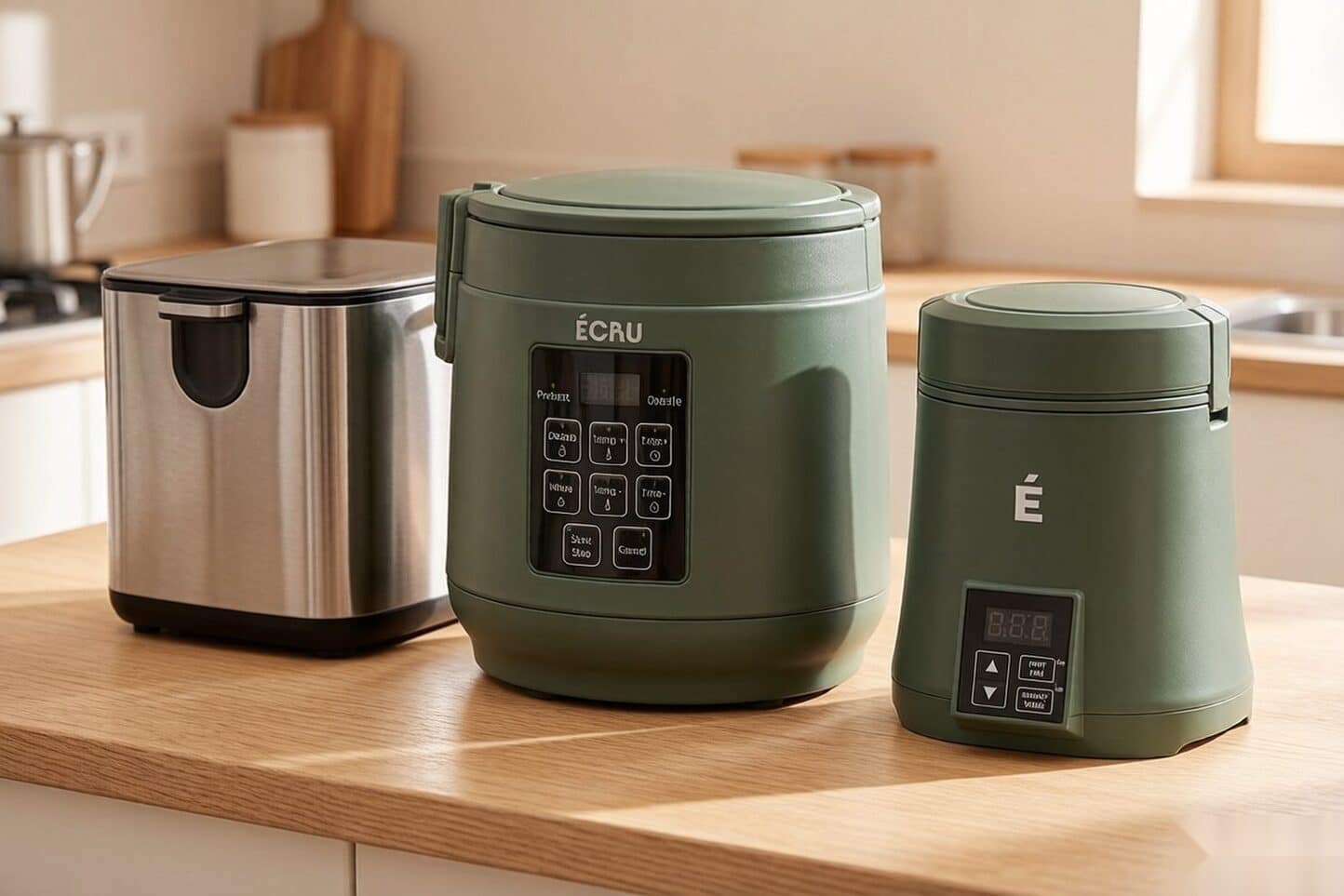
A lineup of countertop decarboxylators for comparison (illustration).
Disclosure first: we make and sell three of the machines in this guide. Every specification below comes either from our own published product data, which we can verify, or is attributed as a manufacturer or retailer figure that you should confirm before buying. Where a competitor's number is unclear, we say so instead of guessing.
How to pick a decarboxylator machine: what to check, what temperature and timing look like, and where a decarboxylator and infuser in one unit fits.
Quick answer: which decarboxylator to buy
If you already own an oven and a thermometer, you do not need a machine: 240°F (115°C) for 30-40 minutes activates flower well enough for occasional batches. A machine earns its price in three cases only - you decarb often, the smell matters where you live, or oven drift keeps producing inconsistent results. Among the units compared here, the ÉCRU 2 in 1 Decarboxylator & Infuser 3oz ($106.99) is the cheapest machine that runs activation and infusion in one canister; the Green 2oz ($86.99) is the small-batch entry point; the 3 in 1 1L ($106.99) is the pick when liquid volume, not flower weight, is the constraint. If you want an established brand and accessory ecosystem instead, Ardent's FX lists $299 for up to 4 oz of dry herb.
How we judged the best decarboxylator machine
Six criteria, in the order they decide results:
- Temperature control. Can it hold a temperature inside the decarboxylation band? This is the whole job.
- Containment. A covered canister keeps aroma and terpenes in. Open trays do not.
- Capacity you can use. Dry capacity counts only while the layer stays thin. Packed full, a large canister decarbs worse.
- Decarb only, or decarb and infuse. Two cycles in one canister removes a transfer step and a second appliance.
- Price, including accessories. Some sell extra canisters and thermometers that others include in the box.
- Verifiability. Whether the published specs hold up - where several established brands get thin.
Decarboxylator comparison table
| Machine | What it does | Dry capacity | Price | Notes |
|---|---|---|---|---|
| ÉCRU 3 in 1 Herbal Infuser Machine 1L | Decarb + infuse, eight presets | 1 oz dry / 250–1,000 mL liquid | $106.99 | Our product; stainless vessel, gentle stirring |
| ÉCRU 2 in 1 Decarboxylator & Infuser 3oz | Decarb + infuse, independent modes | 3 oz dry / 20 oz liquid | $106.99 | Our product; LCD, 350 W |
| ÉCRU Herb Decarboxylator Green 2oz | Decarb + infuse (manual time/temp) | 2 oz dry / 10 oz liquid | $86.99 | Our product; three decarb presets, 275 W |
| Ardent FX | Decarb + infuse | Up to 4 oz (Ardent's published figure) | $299 (Ardent's listed price) | Established accessory line |
| Ardent Mini (redesigned Nova) | Decarb, then infuse in a sleeve | Up to 1 oz flower, 6 oz oil | $240 (Ardent's listed price) | Sealed canister, indicator lights |
| MagicalButter MB2e | Infuse only | n/a for decarb | varies by retailer | Manufacturer states it cannot properly decarb |
| Your oven + oven thermometer | Decarb | Tray size | Free if you own the oven | Smell and drift are the costs |
ÉCRU prices and specs are our own published product data. Ardent's figures come from Ardent's own product pages, read through the Internet Archive because Ardent's live site was not reachable when we re-checked, and the MagicalButter figure comes from MagicalButter's own FAQ. Both are dated to when we read them, so confirm anything that matters before you buy.
The 3 in 1 is the batch-size pick rather than the flower-size pick: the ÉCRU 3 in 1 Herbal Infuser Machine 1L gives up dry capacity (1 oz against 3 oz) to hold a full liter of butter, oil, or tincture in a stirred stainless-steel vessel - the trade to make when the constraint is liquid volume rather than starting material.

The ÉCRU 2 in 1 Decarboxylator & Infuser 3oz with the canister out (illustration).
The problem with decarbing in an oven
Temperature drift. A household oven cycles 20-30°F around its set point. The dial says 240°F; the air above the tray does not. An oven thermometer on the rack beside it tells you the real number.
Smell, and what leaves with it. An open tray vents every aromatic compound into the kitchen for half an hour. Terpenes are the volatile fraction - the smell, and the flavor you were trying to keep. A covered canister holds most of them in.
What temperature and how long does a decarboxylator use
For flower, the working reference is 240°F (115°C) for 30-40 minutes, ground coarse and spread thin - the window the decarb calculator is built around.
Concentrates, kief, and hemp or CBD-dominant material do not convert on the same schedule - the calculator explains why lower temperatures need much longer cycles instead of shorter ones.
A preset removes the dial, the rack thermometer, the timer, and the door you keep opening. It replaces the work of enforcing the band, not knowing it.
Will a decarboxylator make the kitchen smell
Less than an oven does, and not at zero. The material sits in a covered canister instead of an open tray, so terpenes vent inside the unit rather than across the room - and opening it at the end releases what was held in.
The oven side of it - how to decarb without smell in an oven or any open container - is in how to decarb without smell.
How do you know decarboxylation is done
Four cues, none of which need a lab:
- Color. Golden brown through the layer, a shade darker than it went in, with no pale patches.
- Texture. Dry and crumbly, not damp or clumped.
- Smell. Toasty and nutty, not raw and not burnt.
- Uniformity. The bottom reads the same as the top. If not, the layer was too thick.
Compare what you see against the decarb calculator rather than the clock alone.
Is a decarboxylator worth it if I only make edibles occasionally
Honestly, no. If you decarb twice a year, a household oven with an oven thermometer beside the tray does the job for the price of that thermometer. An appliance you store eleven months of the year is a bad trade.
It is worth it when the smell is why you stopped, when drift is costing you material, or when you want the same result every time. The oven versus machine comparison works through that trade with real numbers.
What capacity should I buy
Two numbers show up here: 2 oz and 3 oz dry. Both are larger than they sound, because capacity only counts while the layer stays thin.
- 2 oz covers a typical quarter-ounce to half-ounce batch with room to spare. If your batches sit under an ounce, this is the pick.
- 3 oz is for a half-ounce or more at a time, or one cycle instead of two.
Thin beats headroom: 1 oz in a 3 oz canister decarbs better than a packed one. Buy for what you actually run, not the largest number on the box.
Are cheap decarboxylators safe
Price is not a safety spec, but three things are, and each is checkable in a listing:
- An insulated outer shell. The outside of the unit should not be the heat source.
- A thermostat for the decarb band. A simple on-off heater overshoots - the problem you bought the machine to escape.
- A food-contact rated canister. It holds your material at temperature.
Both ÉCRU units list all three. A listing that publishes none of them is not a bargain at any price.
The machines, one at a time
Best overall value: ÉCRU 2 in 1 Decarboxylator & Infuser 3oz
The machine we would buy for a home edible maker who wants one appliance. It runs independent Decarb and Infuse modes: activation happens in the covered aluminum canister, butter or oil after.
- Capacity: 3 oz dry / 20 oz liquid
- Power: 110V / 60 Hz, 350 W
- Safety: insulated stainless-steel shell, auto-regulating thermostat, FDA-compliant non-stick canister
Best for: regular edible makers, and anyone who finds a $299 machine hard to justify.
See the 2 in 1 Decarboxylator & Infuser 3oz
Best single-purpose machine: ÉCRU Herb Decarboxylator Green 2oz
The smaller unit runs three one-touch decarb presets in a 2 oz canister with an LCD readout, and it can also infuse on a manual time-and-temperature setting - it has no separate Infuse key like the 2 in 1, but the manual prints the infusion procedure and temperature chart for both models.
- Capacity: 2 oz dry / 10 oz liquid
- Power: 110V / 60 Hz, 275 W
Best for: people who mostly decarb and infuse small batches by hand, and anyone whose batches sit under an ounce. See the step-by-step guide and the operating manual for the Green 2oz and 2 in 1.
See the Herb Decarboxylator Green 2oz

The Green 2oz offers preset cycles and an LCD readout (illustration).
Best large-capacity option from the established brand: Ardent FX
The best-known large-format home decarboxylator. It decarbs and infuses, and its accessory line - canisters, sleeves, storage - is more mature than any newer brand's.
Two caveats. Ardent's own FX page, archived March 2026 lists it at $299 and describes it as holding "up to 4 ounces at a time" - more dry-herb ceiling than our 3 oz. What neither of us publishes is how much of that decarbs evenly, which is the only capacity figure that decides a batch. On price the FX is roughly twice our dual-mode unit; the full side-by-side is in our ÉCRU vs Ardent FX comparison.
Best small-batch machine: Ardent Mini
Ardent's smallest unit, the successor to the Nova: a sealed canister with indicator lights. Ardent's own Mini page, archived June 2026 lists it at $240 and rates it at up to 1 oz of flower depending on density, plus 6 oz of oil. We compare it with our Green 2oz in ÉCRU vs Ardent Nova.
Not a decarboxylator, but worth owning: MagicalButter MB2e
The MB2e is an infuser, and the manufacturer says plainly that you cannot properly decarboxylate in it - the same brand sells a separate DecarBox and decarb thermometer for that step. Not a criticism, a description. If you already own one, activate separately: see Do you need to decarb before MagicalButter?
Best free option: your oven
Set 240°F (115°C), spread a thin layer on parchment, put an oven thermometer beside the tray, run 30-40 minutes, stir once. The numbers are in the decarb calculator, not in the dial.

The free option: your oven, plus an oven thermometer and a thin layer (illustration).
Devices we did not rank
Several products come up in this category and are left out deliberately:
- Concentrate and cannabis brewers (LEVO-style devices) are infusion-first appliances. We did not verify a decarboxylation spec, so they are not ranked.
- DIVAs and mason-jar-in-an-oven setups are a technique, not a product, and the temperature claims around them are folklore.
- Dehydrators and toaster ovens appear in guides because people own them. A dehydrator cannot reach the decarb band, so those guides send you to a hotter appliance.
If a device's decarboxylation temperature is not published, that is information, not an invitation to assume.
What actually decides the purchase
Three questions, in order:
- How often do you decarb? Once a month, the oven wins. Weekly, a machine pays for itself.
- How much at a time? Under an ounce, a 2 oz canister is enough; consistently more, capacity decides.
- Do you want to infuse too? If yes, a dual-mode unit removes a second appliance and a transfer step.
The short version
The best decarboxylator is a covered, temperature-controlled canister sized to your actual batches. On price and dual-function terms that is the ÉCRU 2 in 1 Decarboxylator & Infuser 3oz; on single-purpose simplicity the Green 2oz; on brand history an Ardent FX or Mini, if you verify the capacity yourself. If you decarb twice a year, the best machine is the oven you already own, run against published numbers instead of hope.
The ÉCRU decarboxylator machine shop compares both current models on capacity, liquid capacity, controls, and price in one table.
Frequently asked questions
- What is the best decarboxylator for home use?
- For most people making edibles at home, the best decarboxylator is a covered, temperature-controlled canister sized to the batches they actually run. Our pick for value is a dual-mode unit, and the ÉCRU 2 in 1 Decarboxylator & Infuser 3oz is the cheapest machine we found that runs both cycles in one canister.
- Do I need a decarboxylator if I have an oven?
- No. A household oven at 240°F (115°C) for 30-40 minutes with an oven thermometer beside the tray activates flower well enough for occasional batches. A machine earns its place when the smell matters, when you decarb often, or when oven drift keeps producing inconsistent results.
- Can a decarboxylator make butter?
- A decarboxylator activates the material; a unit that also infuses can then make butter or oil in the same canister. The ÉCRU 2 in 1 runs independent Decarb and Infuse modes and holds 20 oz of liquid. A decarb-only machine activates, and you infuse somewhere else.
- What capacity should I buy?
- Buy for the amount you actually run, not the biggest number available. A 2 oz canister covers a typical quarter-ounce to half-ounce batch, and a thin even layer matters more than headroom. Overpacking a canister slows heat transfer and produces patchy decarboxylation.
- Are cheap decarboxylators safe?
- Check three things regardless of price: an insulated outer shell, a thermostat designed for the decarb band rather than a simple on-off heater, and a food-contact rated canister. The ÉCRU units list an insulated stainless-steel shell, an auto-regulating thermostat, and an FDA-compliant non-stick canister.
- Is an Ardent decarboxylator worth the extra money?
- You are paying for brand history, a mature accessory ecosystem, and a design that has been iterated for years. On price the FX sits at $299 against our $106.99, and it does list a higher dry-herb ceiling, up to 4 oz against 3 oz. Per dollar of capacity the ÉCRU still works out cheaper. If you already own Ardent canisters, that changes the math.
- Can a Magical Butter Machine decarb?
- No. MagicalButter's own FAQ states that you cannot properly decarboxylate in the MB2e, and the brand sells a separate DecarBox and decarb thermometer for that step. It is a capable infuser, but it does not belong on a list of decarboxylators.
- How long does a decarboxylator take?
- For flower, the working reference is 240°F (115°C) for 30-40 minutes. A preset cycle runs inside that window, so you set the canister and wait instead of watching a dial and opening a door to check.
More guides
- How to Decarb Without Smell: 7 Methods That WorkDecarb cannabis without filling the house with smell. Compare oven tricks, mason jars, smell-proof bags, and countertop decarboxylators for odor control.August 28, 2026
- Decarboxylator vs Oven: Temps, Smell & CostCompare a decarboxylator vs oven for cannabis decarbing, including temperature control, smell, cleanup, cost, and which method fits your routine.August 26, 2026
- How to Decarb Weed at Home: Temperature & TimeHow to decarb weed (cannabis) at home: a 240°F temperature and time chart, step-by-step oven and decarboxylator methods, and common decarb questions answered.August 20, 2026
- Ardent FX vs ÉCRU: Price, Capacity & PerformanceCompare the ÉCRU 2-in-1 Decarboxylator & Infuser 3oz and the Ardent FX on price, capacity, decarb performance, infusion, build quality, and who each is for.August 28, 2026
Decarb it the easy way
3 in 1 Herbal Infuser Machine 1L
1 oz dry / 250–1,000 mL liquid · 8 preset modes + Delay Start
2 in 1 Decarboxylator & Infuser 3oz
3 oz dry / 20 oz liquid · Independent Decarb and Infuse modes
Herb Decarboxylator Green 2oz
2 oz dry / 10 oz liquid · 3 preset heat cycles
Questions about this method or your ÉCRU? Contact ÉCRU support — warranty, shipping, and returns help in one place.