
Decarb Temperature Chart: Times and Temps That Work
Written by the ÉCRU team · Published August 29, 2026
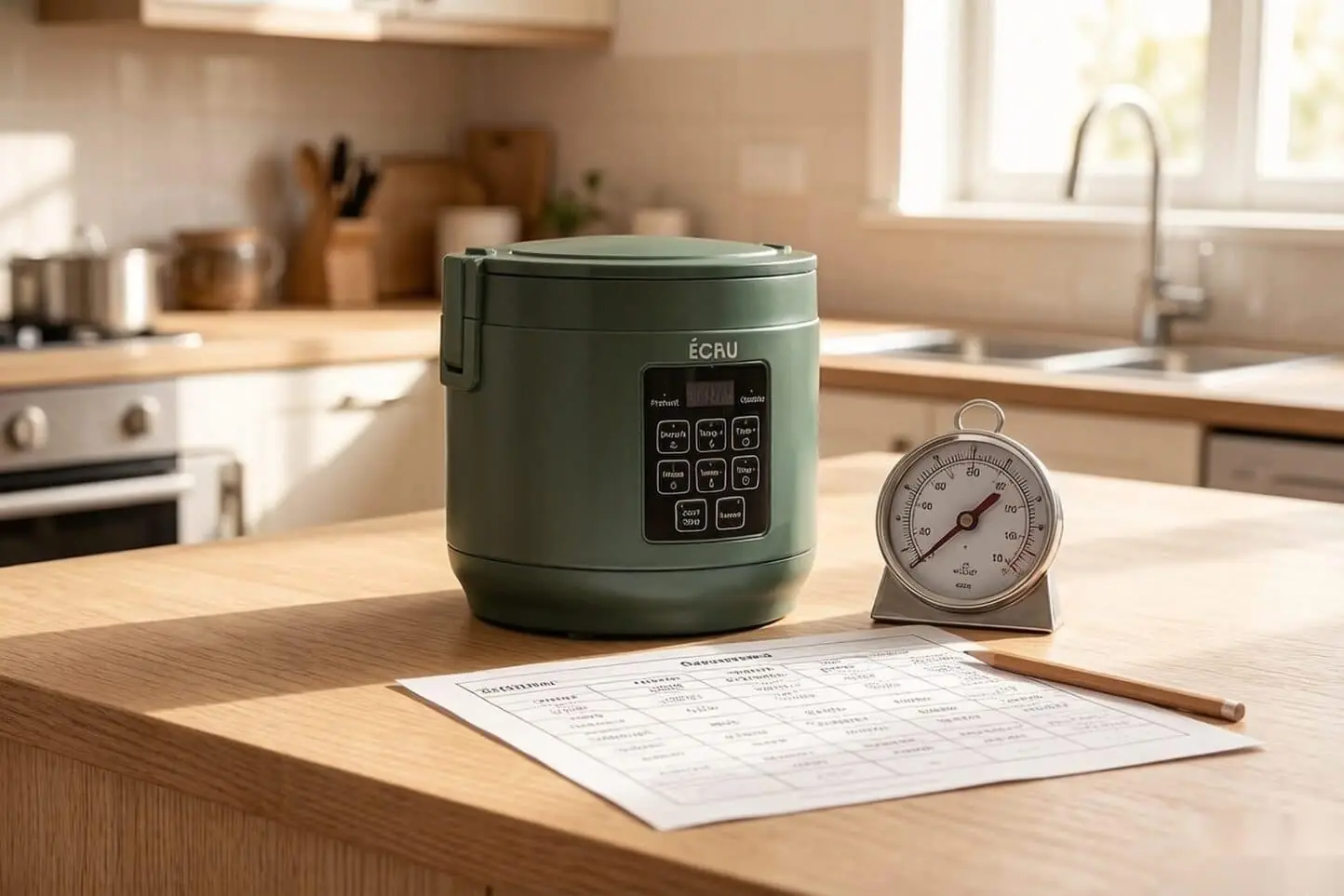
A temperature chart, an oven thermometer, and a countertop decarboxylator (illustration).
Quick answer: a working decarb temperature chart
For most home batches, 240°F (115°C) for 30-40 minutes is the starting point for THC-dominant flower. Denser or concentrate-rich material gets a lower temperature and a longer watch window; hemp and high-CBD material usually needs more time at the same heat.
| Material | Temperature | Starting time | Endpoint cue |
|---|---|---|---|
| High-THC flower | 240°F / 115°C | 30-40 min | Even golden brown, dry and crumbly |
| Terpene-focused flower | 220-230°F / 105-110°C | 40-55 min | Light brown, noticeably aromatic |
| Trim and fan leaf | 240°F / 115°C | 30-40 min | Dry, crumbles when pinched |
| Kief | 240°F / 115°C | 25-35 min | Pale gold to light brown, free-flowing |
| Hash and dry-sieve concentrates | 220-240°F / 105-115°C | 25-35 min | Bubbling slows, layer looks uniform |
| High-CBD hemp | 240-250°F / 115-120°C | 45-60 min | Color shift, no green pockets |
Those are home working ranges, not laboratory endpoints. The reason they are ranges is the chemistry below: decarboxylation speed depends on temperature and time together, and a household oven never holds one number exactly.
What the numbers on a decarb temperature chart actually mean
A decarb chart is a trade-off table, not a switch. Two different things happen when you heat cannabis:
- Conversion. Acidic cannabinoids such as THCA and CBDA lose a carboxyl group and become THC and CBD. This is the reaction you want.
- Degradation and loss. Prolonged or aggressive heat converts THC into CBN and drives off volatile aromatic compounds. This is the reaction you are trying to avoid.
Conversion speeds up with temperature far more than most cooks expect. In a 2016 peer-reviewed study of cannabis extracts, raising the temperature from 80°C (176°F) to 110°C (230°F) sped up THCA loss by roughly a factor of ten. That is why the useful part of a home chart is narrow: about 200°F to 260°F (93°C to 127°C). Below it, you need hours. Well above it, you are trading potency for speed.
The research behind the chart
The most-cited home-kitchen reference for decarb temperature and time is Wang et al. (2016), Decarboxylation Study of Acidic Cannabinoids (Cannabis and Cannabinoid Research, 1(1):262-271, doi:10.1089/can.2016.0020). It measured how fast three acidic cannabinoids disappeared at fixed temperatures in a vacuum oven.
Reported first-order rate constants (x10⁻³ s⁻¹):
| Cannabinoid acid | 80°C / 176°F | 95°C / 203°F | 110°C / 230°F | Activation energy |
|---|---|---|---|---|
| THCA-A | 0.18 | 0.66 | 1.83 | 88 kJ/mol |
| CBDA | 0.05 | 0.27 | 0.83 | 112 kJ/mol |
| CBGA | 0.06 | 0.25 | 1.00 | 109 kJ/mol |
Converted into the form that is easier to use in a kitchen - half of the remaining acid consumed, and effectively all of it consumed:
| Cannabinoid acid | Half-life at 95°C / 203°F | Half-life at 110°C / 230°F | ~99% converted at 110°C |
|---|---|---|---|
| THCA-A | ~18 min | ~6 min | ~42 min |
| CBDA | ~43 min | ~14 min | ~1.5 h |
| CBGA | ~46 min | ~12 min | ~1.3 h |
Those time columns are calculated from the published rate constants (t½ = ln2/k; ~99% = ln100/k). The paper itself does not publish half-lives, and the study used cannabis extracts in a vacuum oven, not jars of flower in a kitchen. Its own wording is the safest summary: "At temperatures lower than 100°C, the reaction did not reach completion within 60 min," and "At higher temperatures, the concentration of THCA-A approached zero in 30, 9, and 6 min at 110°C, 130°C, and 145°C, respectively." If you would rather run ln2/k on your own numbers than read a table of someone else's, the decarb calculator applies these rate constants to your material, temperature, and time.
Three practical readings follow from this table.
- THCA decarboxylates roughly twice as fast as CBDA or CBGA at the same temperature. A chart built for THC flower will under-cook high-CBD hemp, which is why the hemp row above carries a longer time.
- Below about 200°F (93°C), you are committing to a long cycle. The authors could not finish the reaction in an hour at their two coolest settings.
- The CBD and CBG acids are messier than the THCA row suggests. In the same study, side reactions accounted for an estimated 18% of CBDA loss and up to 53% of CBGA loss - those acids do not cleanly become one neutral cannabinoid, so precision charts for CBD and CBG products carry more uncertainty.

Verify the temperature next to the material, not below it (illustration).
Degradation: the top of the chart is where batches get ruined
The reaction that ruins a batch is the one the chart has to warn about. In work cited by the same paper, pure THCA-A held at 160°C (320°F) and 180°C (356°F) for 15 minutes completed decarboxylation but produced CBN, an oxidation-related degradation product. At the other end of the practical window, the study observed that Δ9-THC formation peaked after roughly 5-10 minutes at 145°C (293°F) and then declined at longer times, which the authors attributed in part to evaporation.
Read together, that is the argument for the boring middle of the chart: enough heat and time to finish conversion, and no more. If your material smells scorched or looks dark brown rather than golden, the chart stopped being a guide and became a record of losses.
Decarb temperature chart by cannabinoid profile
| Dominant acid | Practical home setting | Time window | What to know |
|---|---|---|---|
| THCA (most cannabis flower) | 240°F / 115°C | 30-40 min | Fastest of the three major acids; the reference row |
| CBDA (hemp, high-CBD flower) | 240-250°F / 115-120°C | 45-60 min | Slower and less clean; side reactions consume part of the yield |
| CBGA (CBG-dominant genetics) | 240-250°F / 115-120°C | 45-60 min | Slowest in the cited study, with the largest share of side reactions |
| THCA + CBGA (balanced) | 240°F / 115°C | 40-50 min | Set the cycle for the slower acid, not the faster one |
| Already-activated distillate | Do not re-run a chart | - | Decarbed at the factory; added for potency, not activation |
CBCA and the minor acids are much less studied than the three rows above. Where you see a chart giving CBCA a precise temperature and time, treat that number with the same skepticism you would give any unsourced figure in a kitchen blog post.
Decarb temperature chart by starting material
| Material | Temperature | Time | Handling note |
|---|---|---|---|
| Ground flower | 240°F / 115°C | 30-40 min | Coarse grind, single layer, stir once |
| Trim and fan leaf | 240°F / 115°C | 30-40 min | Thin, airy layer; low potency per gram, so batch volume matters |
| Kief | 240°F / 115°C | 25-35 min | Very thin layer; it heats fast and clumps if it gets hot |
| Hash (dry sieve, bubble) | 220-240°F / 105-115°C | 25-35 min | Break into crumbs; dense clumps stay cool in the middle |
| Wax, shatter, BHO | 220-240°F / 105-115°C | 20-35 min | Bubbling is moisture leaving; wait for it to settle |
| Frozen-fresh or damp flower | 240°F / 115°C | 40-50 min | Dry it first if you can; moisture buffers the temperature at the material |
Kief, hash, and concentrates are covered in detail in the hash and concentrate decarb guide and the kief decarb walkthrough, because their behavior is different enough from flower to need its own endpoint cues.
Why two batches at the same setting turn out different
A chart describes the material, not your appliance. Five variables sit between the table above and your finished batch:
- Oven accuracy. A dial set to 240°F can swing 20-30°F around that point as the element cycles. Verify with an oven thermometer placed beside the dish, not stored in a drawer.
- Layer thickness. Heat reaches the top surface first. A heaped tray decarbs unevenly no matter what the dial says.
- Moisture. Wet material spends part of the cycle evaporating water before it climbs to the target temperature.
- Starting acid ratio. Cannabis already loses some acidic cannabinoids during drying and storage. In a 2024 study of dried hemp flowers, the CBD-to-CBDA ratio shifted from roughly 1:99 in fresh glandular content to about 1:20 in the same flowers after 15 days of air drying. Your starting material is never 100% acid, so a chart is a target rather than a full conversion story.
- Oxygen and light. The kinetics table above comes from a vacuum oven, chosen by the authors precisely to remove oxygen and light from the equation. A kitchen has both, which is one reason gentle, contained heat beats aggressive heat.
If you want a number you can trust rather than a range, there are only two routes: send a finished sample for laboratory testing, or keep batch notes and let your own results accumulate.
Using the chart with a countertop decarboxylator
A machine does not replace the chart; it removes two of the variables in the section above. The ÉCRU Herb Decarboxylator Green 2oz runs three preset heat cycles in a covered aluminum canister with an auto-regulating thermostat, which addresses the two biggest causes of failed decarbs - temperature drift and an exposed tray. The ÉCRU 2 in 1 Decarboxylator & Infuser 3oz adds an independent Infuse mode, so the decarbed material goes straight into butter or oil in the same canister.

A covered canister removes oven drift and open-tray exposure (illustration).
Two honest limits on this:
- Preset cycles are programs, not a dial you can set to 240°F exactly, and the exact internal temperature of each preset is not something we have measured and published. Follow the manual's cycle guidance for your material.
- Listed capacities (2 oz dry for the Green 2oz, 3 oz dry for the 2 in 1) are dry flower figures. Concentrates need much smaller batches; do not read a dry-herb capacity as a hash capacity.
We do not publish a measured temperature curve for our own devices because we do not have one yet. The owner-side measurement protocol that would let this page make that claim is in the accompanying audit notes, and the honest framing above stays until those numbers exist.
How to tell whether your batch finished
Color and texture are the only home tests available, and they are indicators rather than proof:
- Green to golden brown. Chlorophyll and the acid-to-neutral change both shift color. Green patches mean cold spots.
- Dry and crumbly, not damp or spongy. Moisture means the material never reached a steady temperature.
- Toasty, not burnt. A sharp acrid smell means you exceeded the useful range of the chart.
- Uniform through the layer. Flip a few pieces from the middle of the pile and compare them with the edge.

Golden and evenly decarbed material compared with a darker, overheated batch (illustration).
The full mechanism behind these cues is covered in what decarboxylation is and how it works, and the step-by-step oven and machine procedures are in the cannabis decarboxylation guide.
Safety and preparation notes
Work in a ventilated kitchen, use oven-safe glass, metal, or parchment rated above your target temperature, and never seal a container airtight while it heats. Keep hot canisters and trays out of reach of children. Cannabis concentrates and decarbed material look exactly like edible crumbs; label everything. That warning has a regulatory tail: the FDA's 2022 advisory on THC food products was issued because accidental ingestion can cause serious adverse events, especially in children, with more than 10,000 single-substance THC-food exposures reported to poison control centers in its tracking window.
Laws differ by state and country. This chart is for adults working with material that is legal where they live, and it is not medical advice. Never attempt home extraction with butane or other volatile solvents.
The short version
Set the chart by what is in front of you: 240°F (115°C) for 30-40 minutes for THC-dominant flower, 25-35 minutes and a thinner layer for kief and hash, and 45-60 minutes for high-CBD hemp, because CBDA moves more slowly than THCA. Verify the temperature where the material sits, keep the layer thin, and treat every published number as kinetics measured in a vacuum oven - not as a promise about your kitchen.
More guides
- How to Decarb Hash: Temperature, Time & MethodLearn how to decarb hash with a temperature and time chart, an oven method, a decarboxylator option, and signs the concentrate is ready for infusions.August 28, 2026
- How to Decarb Kief: Temperature, Time & MethodLearn how to decarb kief at 240°F with a step-by-step oven and jar method, what to watch for, and how to use activated kief in edibles or on top of a bowl.August 25, 2026
- What Is Decarboxylation? A Plain-Language GuideDecarboxylation is the heat-driven step that turns THCA and CBDA into THC and CBD. What it does, when it happens by itself, and how to control it at home.August 29, 2026
- How to Decarb at Home: Temperature Chart & MethodsDecarb cannabis correctly with this temperature and time chart, step-by-step oven and decarboxylator methods, and answers to common decarb questions.August 20, 2026
Decarb it the easy way
Herb Decarboxylator Green 2oz
2 oz dry / 10 oz liquid · 3 preset heat cycles
$99.99View product2 in 1 Decarboxylator & Infuser 3oz
3 oz dry / 20 oz liquid · Independent Decarb and Infuse modes
$129.99View product
Questions about this method or your ÉCRU? Contact ÉCRU support — warranty, shipping, and returns help in one place.