
Glycerin Tincture vs Honey vs Oil: Carrier Guide
Written by Stefan Cave · Published November 21, 2026
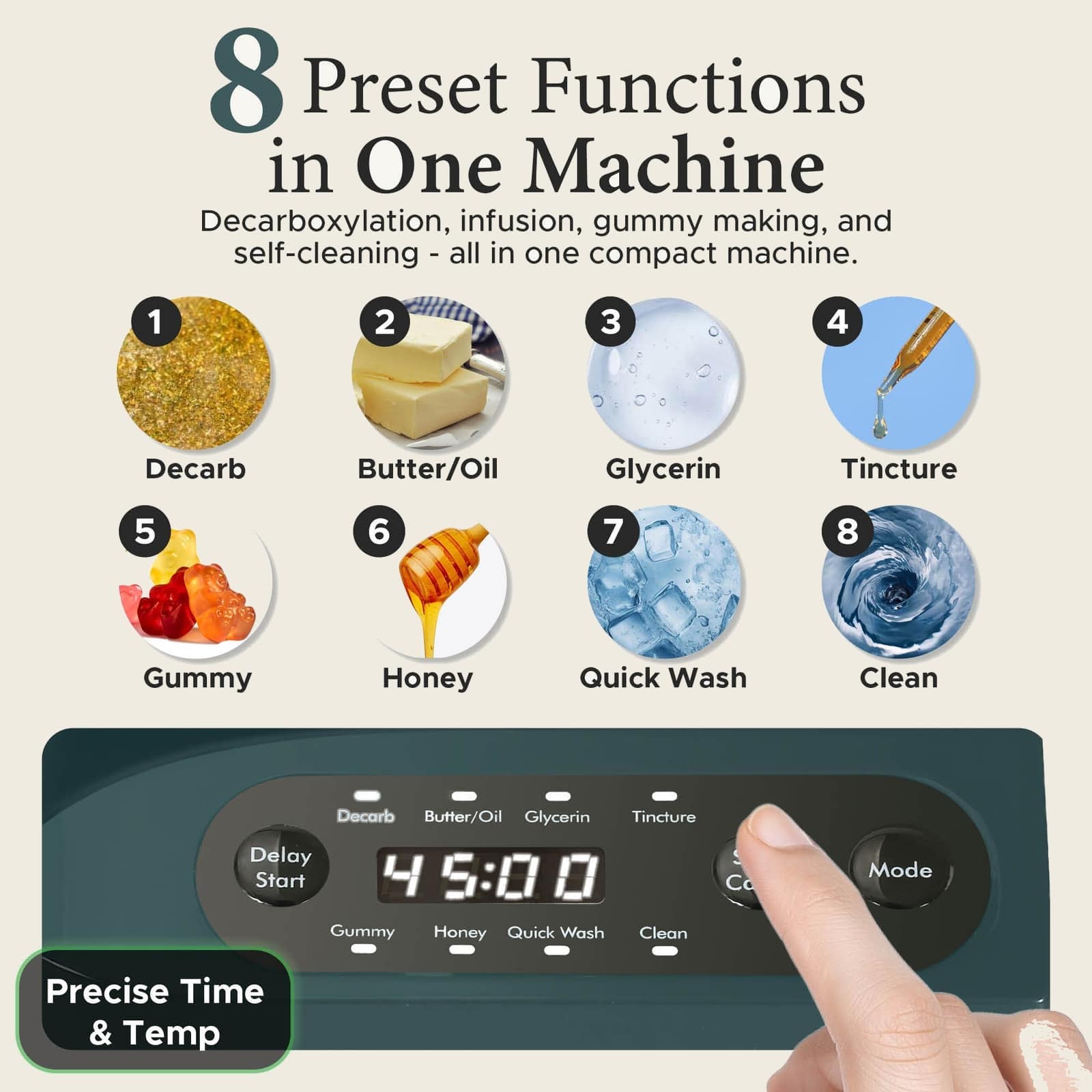
The preset panel this guide refers to (product photo).
Quick answer: which carrier to use
Butter or cooking oil is the default for anything you will eat, because fat carries the most cannabinoids per gram and holds up to heat. Glycerin makes a gentler, alcohol-free tincture that extracts less and takes longer. Honey gives a sweet carrier that scorches easily, so it needs a preset that holds a low, stirred temperature. Decarb the flower first in every case - the carrier determines what you get out of it, not whether the plant material was activated.
Why the carrier matters more than the recipe
Once the herb is decarbed, the carrier decides two things: how much of the active material ends up in the finished product, and what you can do with it. Fat does both jobs well and that is why cannabutter and infused oil are the default. Glycerin and honey are chosen for reasons other than potency - no alcohol in the finished tincture, or a sweet carrier for a specific recipe - and the trade is almost always strength.
This matters for buying a machine: a unit that only holds butter and oil is a complete setup for cooking. One that also runs glycerin, tincture, honey, and gummy presets is aimed at people who want those carriers without juggling a double boiler on the stove.
Decarb is the shared first step
Every carrier in this guide starts from activated flower. Run the decarb cycle first at 240°F (115°C) for 30-40 minutes with the flower spread thin, then cool it 10-15 minutes before it goes into the carrier. If you want the temperature and timing for a specific material - trim, kief, hash, high-CBD hemp - the decarb calculator gives a recommended cycle and endpoint for each.
The reason the steps are separate on a machine preset is not ceremony. A decarb run is a dry, hot step; the infusion that follows is wet and much cooler. Running them as one programme means picking a temperature that is wrong for one of them.
Glycerin: the alcohol-free tincture
A glycerin tincture steeps decarbed flower in vegetable glycerin until the cannabinoids move into the liquid, then filters the plant material out. Compared with an alcohol tincture it extracts less and takes longer, which is the honest trade: what you gain is a finished tincture with no ethanol in it.
On a machine with a glycerin preset, the work is the temperature hold and the stirring. Glycerin is thick, and a gentle stir is what stops the herb from settling into one hot spot and scorching there.
Honey: a carrier that scorches first
Honey is almost all sugar with very little water, so it goes from warm to burnt far faster than butter or oil. A stirred preset that holds a low temperature is the difference between infused honey and a pan of caramel stuck to the bottom.
Use it where you want the sweetness to carry the dose - stirred into tea, drizzled over something, or used in a recipe that expects honey anyway. Because it is mostly sugar, it will not carry as much per gram as fat.
Oil tinctures: the same carrier, a different target
An oil tincture is a fat infusion made to be dosed by the dropper, not cooked with. That changes what you optimise for: a hard strain so nothing clogs the dropper, and a higher herb-to-carrier ratio so a small volume carries a meaningful dose. The fat itself is doing the same extraction job as in cannabutter.
If that is the goal, strain more carefully than you would for butter and skip the squeezing - plant waxes in a dropper bottle are the one thing you cannot strain out later.
How strong will it be?
We will not give you a milligram number for a homemade infusion, because nobody can without a lab test. What is reproducible is the arithmetic: grams of flower times the lab THCA percentage times 10, times 0.877, gives the ceiling of neutral cannabinoid a batch can hold. That is the calculation behind the cannabutter dosing chart, and the same ceiling logic applies here - then discount it for the carrier.
Glycerin extracts less than fat, so a glycerin tincture from the same flower will come in under the butter number from the same arithmetic. Treat the figure as a starting estimate rather than a label.
Which machine handles which carrier
A canister model holds butter and oil well and is the right buy if cooking is all you need. A unit with dedicated glycerin, tincture, honey, and gummy presets is built for the rest of this list; the ÉCRU 3 in 1 runs those presets in its 1,000 mL vessel, along with a separate decarb cycle, which is the combination that makes all of the above possible in one appliance. Its smell-control lid and stirred vessel matter more here than on a butter run, because a long glycerin steep is the run most likely to scorch.
Whichever unit you use, the order stays the same: decarb, cool, then infuse the carrier at its own temperature.
Frequently asked questions
- What is a glycerin tincture?
- A glycerin tincture steeps decarbed herb in vegetable glycerin instead of alcohol. It extracts less than an alcohol tincture and takes much longer, but it contains no ethanol, so it suits people who do not want to use drinking alcohol or who find the burn under the tongue unpleasant. The trade is potency for gentleness.
- Does a machine make a glycerin tincture in one cycle?
- No. Decarboxylation is its own cycle, then the glycerin runs as a separate infusion preset at a lower temperature. Splitting the steps is what keeps the decarb heat from degrading the carrier before it has extracted anything.
- Can I infuse honey in a decarboxylator?
- A unit with a dedicated honey preset can. Honey is mostly sugar with very little water, so it scorches long before it boils; a preset that holds a gently stirred low temperature is what keeps it usable. A stovetop honey infusion needs constant watching for the same reason.
- Is an oil tincture the same as butter?
- No. Both are fat infusions, but a tincture is meant to be taken by the drop from a dropper bottle, so it is strained hard and often run at a higher herb-to-carrier ratio. Butter and cooking oil are for recipes, where flavour and texture matter more than concentration.
- How strong is a homemade glycerin or honey infusion?
- Weaker than an oil or butter infusion from the same flower, and impossible to promise a number for without a lab test. Glycerin extracts less of the cannabinoids than fat does, which is why recipes suggest a longer steep. Treat any homemade infusion as variable and start low.
More guides
- Cannabutter Dosing Chart: mg per Tbsp and CookieA cannabutter dosing chart with worked milligram math: mg per tablespoon and per cookie, the 0.877 conversion regulators use, and safe starting doses.September 9, 2026
- Best Decarboxylator and Infuser MachinesThe best decarboxylator and infuser options compared on temperature control, capacity, smell, and price - with honest criteria and real specs.August 27, 2026
- How to Decarb Weed at Home: Temperature & TimeHow to decarb weed (cannabis) at home: a 240°F temperature and time chart, step-by-step oven and decarboxylator methods, and common decarb questions answered.August 20, 2026
- LĒVO vs ÉCRU: Batch Size, Price & Odor ComparedLĒVO C, LĒVO II+, and the ÉCRU 2 in 1 compared on published batch size, price, odor control, and who each machine actually suits.November 21, 2026
Decarb it the easy way
3 in 1 Herbal Infuser Machine 1L
1 oz dry / 250–1,000 mL liquid · 8 preset modes + Delay Start
2 in 1 Decarboxylator & Infuser 3oz
3 oz dry / 20 oz liquid · Independent Decarb and Infuse modes
Questions about this method or your ÉCRU? Contact ÉCRU support — warranty, shipping, and returns help in one place.